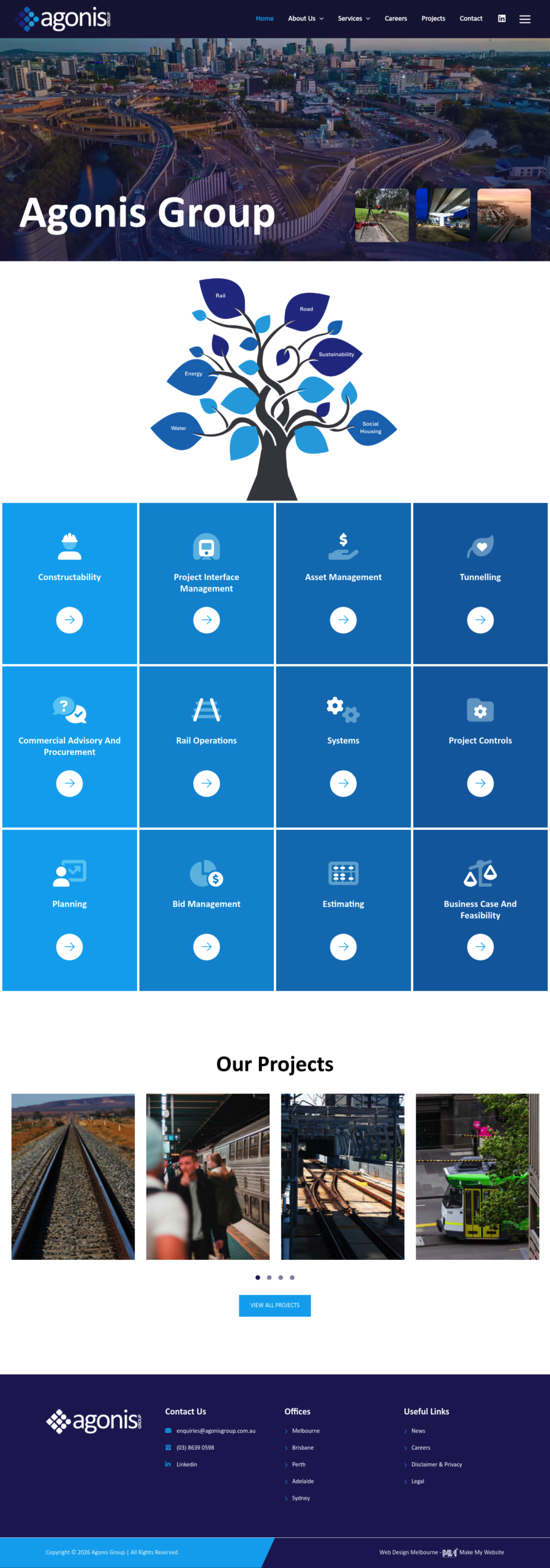
Agonis Group has built clear sector credibility in Melbourne and nationally through interdisciplinary civil and infrastructure work, listing major programs such as Sydney Metro, and offering specialist services from tunnelling to project controls and commercial advisory. That real-world experience and a 5.0 Google rating are not translating into procurement-ready evidence on the pages where shortlisting decisions are made. As a result, government and private sector procurement leads are landing on the site but not finding the quantified outcomes, client references or sector-specific case studies they need to shortlist Agonis for high-value projects.
Your online reputation
5
Google star rating
1
Verified reviews
High
Reputation strength
Google Business Profile
Your online presence — what the data reveals
AI Visibility
Low
Authority Score
15
out of 100
Organic traffic
202
est. monthly visits
Traffic Trend
+37
%
past 12 months
Organic Keywords
64
ranking terms
Keyword Trend
-18
%
past 12 months
Backlinks
371
total
Paid traffic
0
0 paid campaigns
Digital maturity
Level 2
out of 5
You have two hard-to-copy assets: direct involvement in major Australian infrastructure programs, including Sydney Metro projects, and an existing backlink footprint of 371 backlinks from 125 referring domains. Those reflect real project experience and third-party recognition that competitors would struggle to match quickly. If your online presence brings that evidence forward in procurement-ready formats, those assets can turn into more qualified enquiries and stronger shortlist outcomes.
How your website scores
TECH STACK
UX OBSERVATIONS
Trust signals are present but not carrying enough visual authority to match a national specialist; absence of prominent client logos, project outcomes or accreditations above the fold dilutes credibility and costs shortlist opportunities.
The service grid treats all offerings as equal and creates choice paralysis; this fails to structure decision-making for complex buyers and increases click friction rather than guiding them toward a qualifying action.
Conversion intent is weak and poorly prioritised; primary CTAs are secondary to navigation and projects, and there is no prominent above-the-fold contact or enquiry prompt to capture high-intent prospects, which will lower lead conversion and raise offline selling costs.
With roughly 200 organic visits per month and an authority score of 15, your real-world project experience is not being discovered by the procurement teams that matter, leaving shortlist opportunities unrealised. A national search rank around 474,094 and a drop in tracked keywords suggest visibility is scattering rather than concentrating on the sector terms decision-makers use, which extends sales cycles and increases the offline work needed to win projects.
The three gaps holding you back
What's possible when these gaps are closed
Turn named projects such as Sydney Metro, Central Station and SW Stations into short, sector-specific case studies with quantified outcomes and client references. Using those project names alongside your existing backlink footprint of 371 backlinks and 125 referring domains will make it much easier for procurement leads to verify capability and move Agonis onto shortlists.
Improve relevance so national rank and authority work for you rather than against you, addressing a national search rank near 474,094 and an authority score of 15 that are currently limiting discovery. Better alignment on the 60 to 64 core keywords could lift the roughly 200 monthly organic visits into a stronger flow of procurement-focused traffic.
Group the many specialist services into clear sector pathways and priority offers so procurement teams can quickly see the right capability without extra explanation. That targeted approach will help reverse the keyword loss from 73 to 60 and reduce the time your team spends educating buyers before a procurement conversation can start.
This report was prepared by Redfox Digital using publicly available SEO, UX and reputation data.