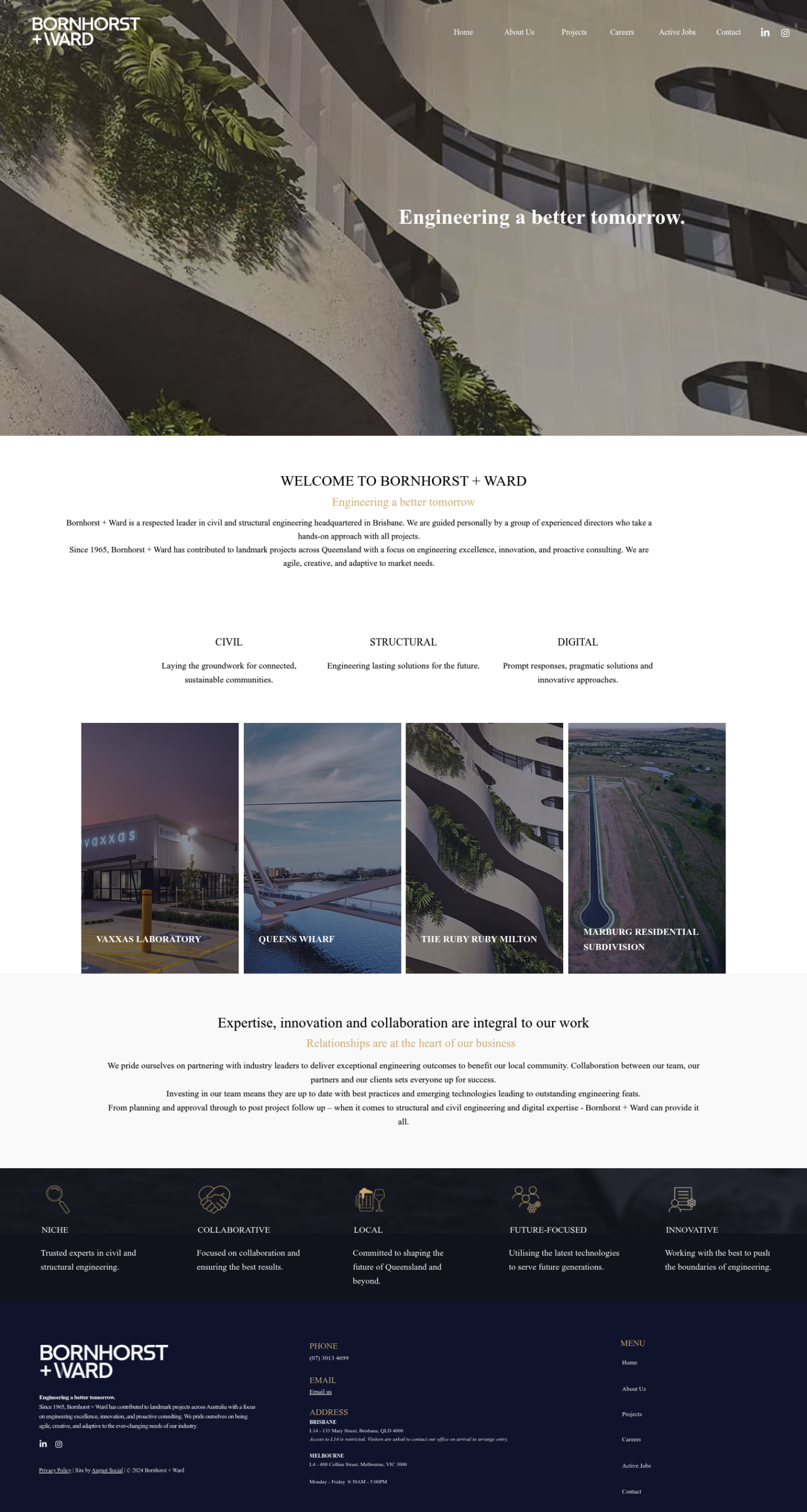
Bornhorst+Ward has built real credibility in Queensland since 1965, delivering landmark projects such as VAXXAS Laboratory, Queens Wharf and The Ruby for developers, builders and government clients. That track record and local relationships are visible, yet only three Google reviews at a 3.7 rating and modest organic traction mean commercial buyers cannot reliably validate your capability where they research suppliers. As a result, higher-value government and developer opportunities are being lost before a direct conversation ever starts.
Your online reputation
3.7
Google star rating
3
Verified reviews
Medium
Reputation strength
Google Business Profile
Your online presence — what the data reveals
AI Visibility
Low
Authority Score
20
out of 100
Organic traffic
561
est. monthly visits
Traffic Trend
+6
%
past 12 months
Organic Keywords
95
ranking terms
Keyword Trend
-14
%
past 12 months
Backlinks
587
total
Paid traffic
0
0 paid campaigns
Digital maturity
Level 2
out of 5
Bornhorst+Ward has an authentic market position few local firms can match: 61 years of continuous practice since 1965 and a portfolio that includes at least three high-profile Queensland projects named on the homepage. Those long-standing relationships with developers, builders and government clients are a durable advantage. If the digital presence catches up, those assets could be converted into a predictable flow of larger, higher-value project enquiries.
How your website scores
TECH STACK
UX OBSERVATIONS
Premium visual styling is not carrying enough commercial authority — buyers seeking technical assurance will not find immediate, verifiable credibility (project metrics, client logos, principal bios) and so pause before engaging.
The page fails to structure decision-making — no primary CTA or contact pathway above the fold weakens conversion intent and prevents a predictable route for high-value enquiries.
Content signals (heritage since 1965, project thumbnails) are under-signalled visually — they exist but are buried in copy and small thumbnails, diluting trust and making it hard to convert procurement or developer leads quickly.
With roughly 550 to 561 organic visits per month and an authority score of 20, the website is getting some attention but not turning that attention into reliable briefs or tender-ready enquiries. Only three Google reviews at a 3.7 rating and a drop from 106 to 91 ranking keywords makes it harder for commercial buyers to quickly validate capability, so many higher-value opportunities quietly go to competitors who present clearer, decision-ready evidence.
The three gaps holding you back
What's possible when these gaps are closed
Make the upside tangible by turning VAXXAS Laboratory, Queens Wharf and The Ruby into short, quantified case studies that show outcomes, team roles and risk mitigation. Presenting three procurement-ready project summaries plus measurable results from a 61 year practice lets buyers compare you directly with alternatives and shortens the time to briefing.
Clarify each service with outcomes, timelines and example costs so developers and government buyers can assess risk at a glance. When outcome-focused pages replace repeated, broad copy, the current ~550 monthly visitors are far more likely to progress from research to contact and to request tender information.
With about 550 monthly visits, roughly 90 ranking keywords and an established backlink profile, there is enough momentum to build a predictable lead flow. Aligning content with straightforward contact paths and a few targeted landing pages will raise the conversion of that existing traffic into regular, qualified enquiries from higher-value clients.
This report was prepared by Redfox Digital using publicly available SEO, UX and reputation data.