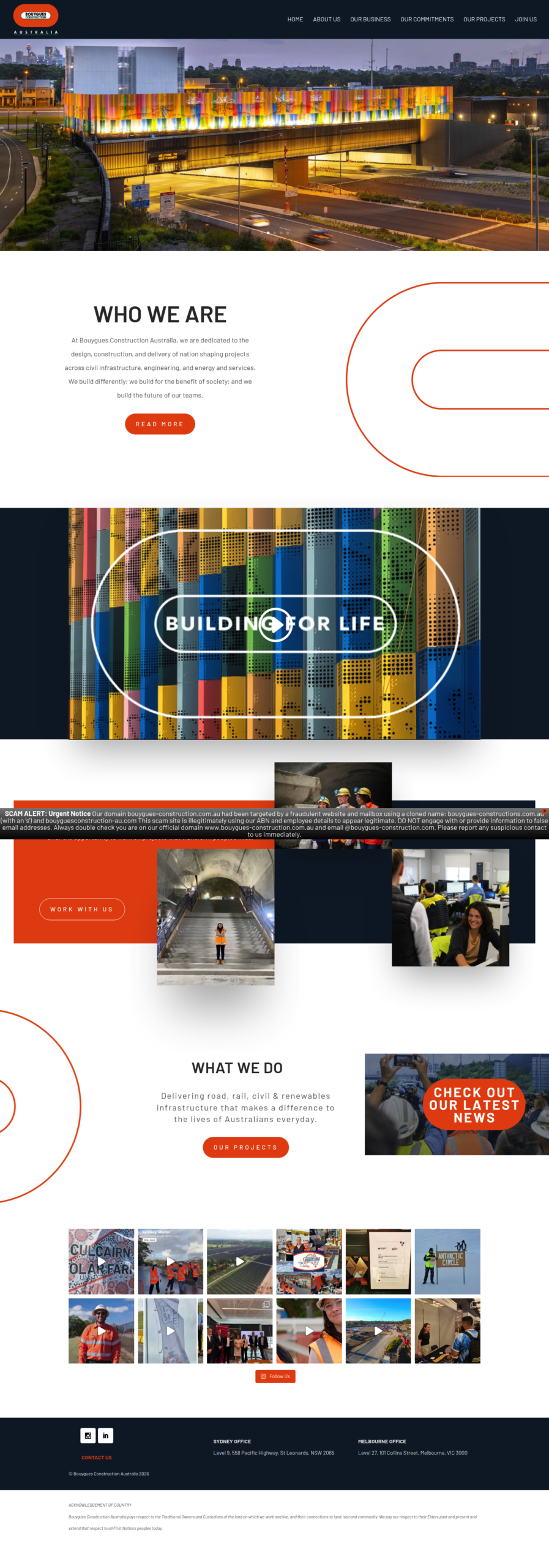
Bouygues Construction Australia has built clear national capability across civil, rail, road, energy and engineering, and benefits from the weight of the Bouygues Group and its 35,600 people. Despite that, the site’s About copy is global and generic, there are no client logos or project KPIs on evaluation pages, and only five Google reviews, so government and large enterprise procurement teams cannot quickly verify capability. With organic traffic down 41% and keywords down 36%, many shortlist opportunities are being lost before a procurement contact is made.
Your online reputation
5
Google star rating
5
Verified reviews
High
Reputation strength
Google Business Profile
Your online presence — what the data reveals
AI Visibility
Low
Authority Score
23
out of 100
Organic traffic
765
est. monthly visits
Traffic Trend
-41
%
past 12 months
Organic Keywords
199
ranking terms
Keyword Trend
-36
%
past 12 months
Backlinks
991
total
Paid traffic
0
0 paid campaigns
Digital maturity
Level 1
out of 5
You already have nation-scale delivery across civil, rail, road and energy projects for government and enterprise, backed by the Bouygues Group’s 35,600 employees. A five-star Google rating across five local reviews signals strong client satisfaction in the market. If the digital presence is shaped to surface sector proof, KPIs and direct procurement pathways, those assets could be turned into more shortlisted opportunities and commercial enquiries.
How your website scores
TECH STACK
UX OBSERVATIONS
Messaging is generic and not prioritised for buyers; consequence: commercial prospects cannot quickly verify capability by sector or find the procurement pathways that trigger qualified enquiries.
Trust cues are present but under-signed and fragmented (no client logos, project KPIs, certifications or procurement contacts) and the persistent scam-alert strip is visually alarming; consequence: credibility is diluted for risk-sensitive buyers and may reduce conversion.
Visual system is polished but fails to structure decision-making or highlight a clear primary CTA; consequence: traffic is likely to browse without a clear action, weakening lead generation and commercial outcomes.
Monthly organic traffic is around 765 (latest month 784) and has fallen 41% year on year, while ranked keywords are down 36%, which means fewer procurement buyers are finding and assessing your capability online. With a national search rank of 206,180 and an authority score of 23, the pool of incoming, qualified government and enterprise enquiries is small and shrinking.
The three gaps holding you back
What's possible when these gaps are closed
Turn your scale and client outcomes into proof that procurement teams can trust quickly. Add client logos, project KPIs and certifications to the pages where buyers evaluate suppliers so decision makers can verify capability in seconds, and lean on the Bouygues Group scale (35,600 people) and a five-star local rating to strengthen shortlisting.
Create dominant, sector-specific procurement CTAs and a clear contact route so the roughly 765 monthly organic visitors have a single, obvious next step. Reframing the homepage and sector pages to prioritise procurement contacts and KPIs will turn casual browsers into measurable, qualified commercial leads.
Reduce visual and informational friction so risk averse government teams proceed to contact rather than drop out. Remove or rework the persistent scam-alert strip, consolidate credibility cues on procurement pages and address the visibility gap behind an authority score of 23 and a national rank of 206,180 to expand the pool of incoming opportunities lost during the 41% traffic decline.
This report was prepared by Redfox Digital using publicly available SEO, UX and reputation data.