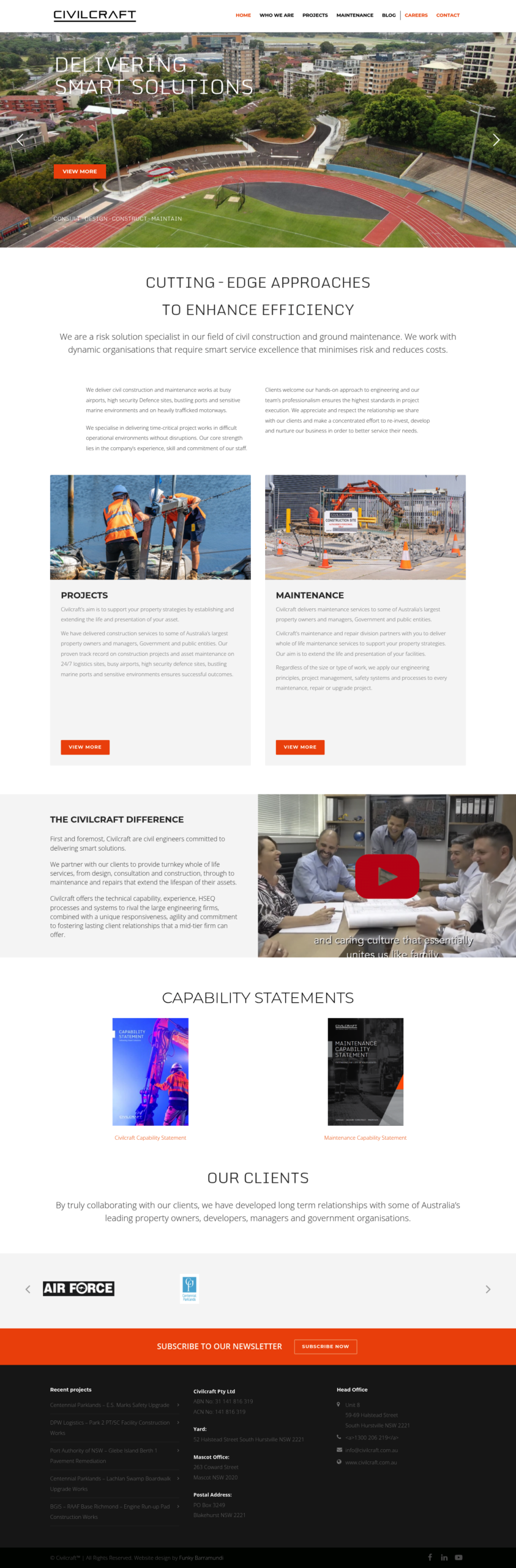
Civilcraft has built hard-won credibility delivering consult, design, construct and maintenance work for airports, defence sites, ports and large property owners from its base in South Hurstville. That offline reputation shows in project lists and referrals, yet it is not translating into qualified online enquiries because procurement teams cannot find shortlist-ready proof or a clear path to engage. Traffic and keywords have risen sharply – sessions jumped from about 123 to 1,702 and keywords from 89 to 1,098 – but authority sits at 13 and national search rank is 106,052, so many large contracts and tender opportunities are still being missed.
Your online reputation
5
Google star rating
2
Verified reviews
Medium
Reputation strength
Google Business Profile
Your online presence — what the data reveals
AI Visibility
Low
Authority Score
13
out of 100
Organic traffic
1819
est. monthly visits
Traffic Trend
+1k
%
past 12 months
Organic Keywords
1258
ranking terms
Keyword Trend
+1k
%
past 12 months
Backlinks
4393
total
Paid traffic
0
0 paid campaigns
Digital maturity
Level 2
out of 5
You already have direct sector credentials across airports, defence and ports and demonstrable operational scale that competitors will find hard to replicate. You also have substantial external signals with 4,393 backlinks from 314 referring domains. Those assets make landing large tenders achievable once the digital presence presents procurement-facing proof and a clear engagement path.
How your website scores
TECH STACK
UX OBSERVATIONS
Trust signals exist (client logos, capability statements, video) but are visually low-weight and poorly prioritised, reducing their ability to convert risk-averse procurement teams into qualified leads.
Content hierarchy favours broad marketing statements over decision-focused content, so complex buyers cannot quickly verify capability, safety credentials or project outcomes and will default to better-signalled competitors.
Primary CTAs are weak and inconsistent (multiple 'View more' and a newsletter push) which fragments conversion intent and fails to create a clear, short path for tender requests, capability downloads or direct procurement contact.
The site is generating more attention – monthly sessions rose from about 123 to 1,702 and keywords climbed from 89 to 1,098 – but that attention is not converting into shortlist outcomes for high-value contracts. With an authority score of 13 and a national rank of 106,052, procurement teams are unlikely to prioritise Civilcraft, so many formal tender opportunities will continue to go to firms who present clearer evidence and engagement paths online.
The three gaps holding you back
What's possible when these gaps are closed
Turn the airports, defence and ports work into sector-specific case studies that show scope, outcomes and procurement-ready evidence. Even adding three detailed case studies with quantified results and downloadable PQQ-ready attachments could convert part of the recent +1,000 session uplift into two or three qualified tender enquiries per quarter.
Convert the jump from about 123 to 1,702 monthly sessions and the rise from 89 to 1,098 keywords into a focused search presence for tender-related queries. Improving authority from 13 and targeting a handful of procurement keywords can make organic demand generation for large contracts reliable rather than accidental.
Create a single download hub for PQQs, scoped evidence and tender materials and a direct path for procurement teams to request documentation. With a simple engagement flow and a small push to grow local proof beyond the current 5.0 Google rating from 2 reviews, shortlist conversion rates could rise noticeably and turn passive visitors into formal enquiries.
This report was prepared by Redfox Digital using publicly available SEO, UX and reputation data.