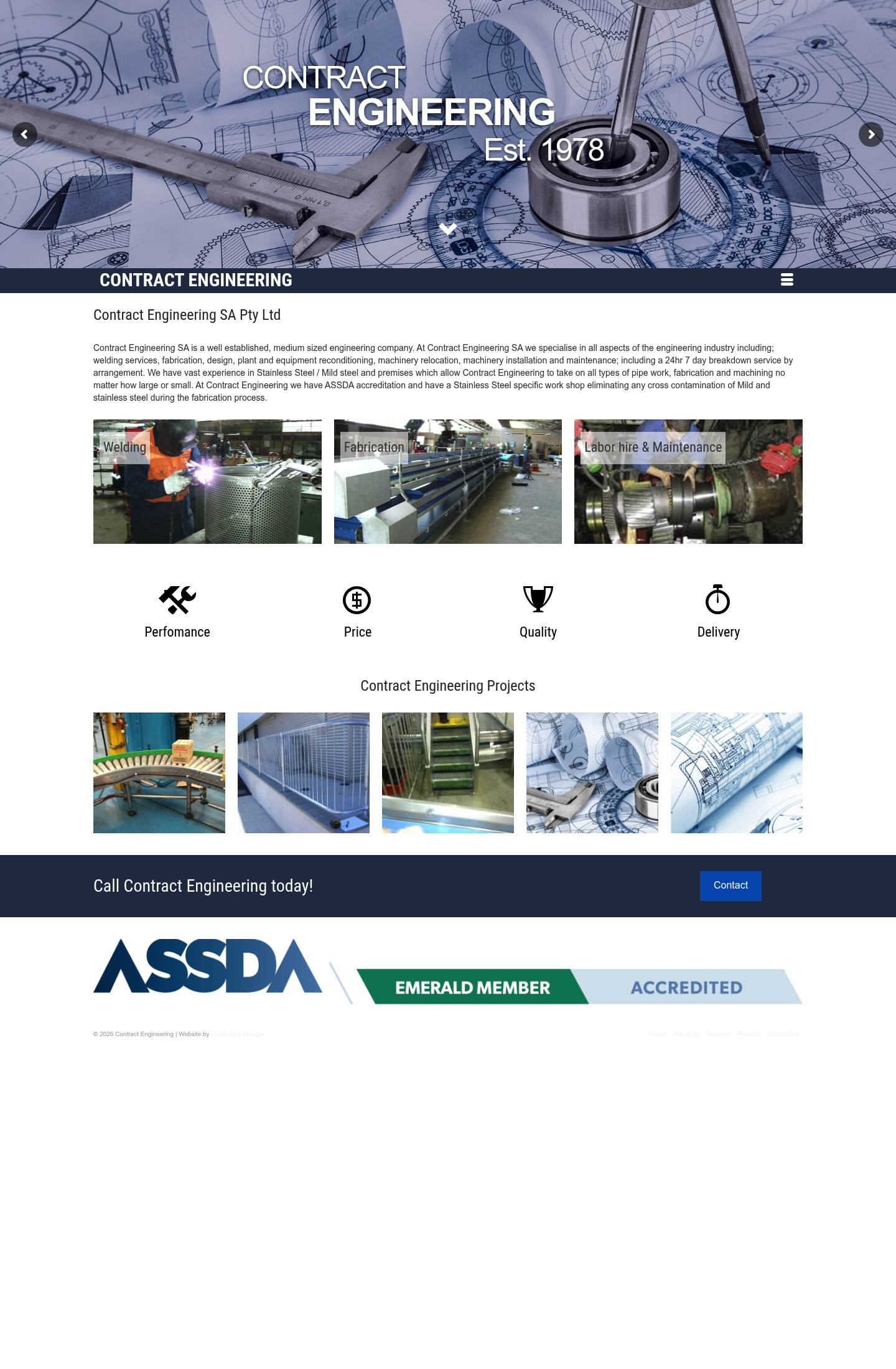
Contract Engineering has built real scale and sector credibility since 1978, with a 25-strong trades team and named projects for Coca-Cola Amatil and Ingham’s. Those assets sit on a Projects page with no case studies, few visuals and no visible accreditations, so commercial buyers cannot judge capability or risk from the site alone. That gap is costing missed shortlists and project enquiries in food and manufacturing procurements.
Your online reputation
5
Google star rating
2
Verified reviews
Medium
Reputation strength
Google Business Profile
Your online presence — what the data reveals
AI Visibility
Low
Authority Score
8
out of 100
Organic traffic
106
est. monthly visits
Traffic Trend
+1k
%
past 12 months
Organic Keywords
26
ranking terms
Keyword Trend
+12
%
past 12 months
Backlinks
294
total
Paid traffic
0
0 paid campaigns
Digital maturity
Level 1
out of 5
You have hard-to-replicate assets: a business founded in 1978 and a 25-strong trades team that has delivered work for major food clients such as Coca-Cola Amatil and Ingham’s. If the digital presence catches up, those assets can make Contract Engineering the obvious pick for large food and manufacturing projects across South Australia.
How your website scores
TECH STACK
UX OBSERVATIONS
Commercial credibility is visible but not carried with enough prominence, so key buyers will miss accreditation and project evidence and will not treat the business as an obvious supplier.
The page fails to structure decision-making for commercial buyers, producing friction for complex enquiries because there is no immediate value proposition, sector-specific paths or clear primary call to action.
Conversion intent is weakened by low-contrast, secondary CTAs and dense copy; consequence is lost direct enquiries and fewer shortlist opportunities from time-poor decision makers.
Only about 106 organic visits a month and a national search rank of 657,490 mean most commercial buyers will not discover the business when shortlisting suppliers. At the same time, listing major clients but having just two Google reviews and no site case studies means buyers who do find you cannot judge capability or risk, so they move on to better-documented competitors.
The three gaps holding you back
What's possible when these gaps are closed
Publish three to five detailed case studies that feature Coca-Cola Amatil and Ingham’s with clear visuals, scope, timelines and outcomes so buyers can assess capability without a call. Well-structured case studies make it much easier to win shortlist spots for larger projects.
Remove the ‘outdated browser’ message, surface ASSDA accreditation on key pages and add clear contact pathways on service pages so each of the roughly 106 monthly visitors recognises your capacity. Simple UX and content fixes will reduce bounce and make enquiries from local food and manufacturing buyers more likely.
Encourage more client reviews and showcase the 25 trades and named projects so a five-star rating with only two reviews becomes a broader record of proven delivery. Turning offline referrals and scale into visible proof will drive more project enquiries and shortlist invitations.
This report was prepared by Redfox Digital using publicly available SEO, UX and reputation data.