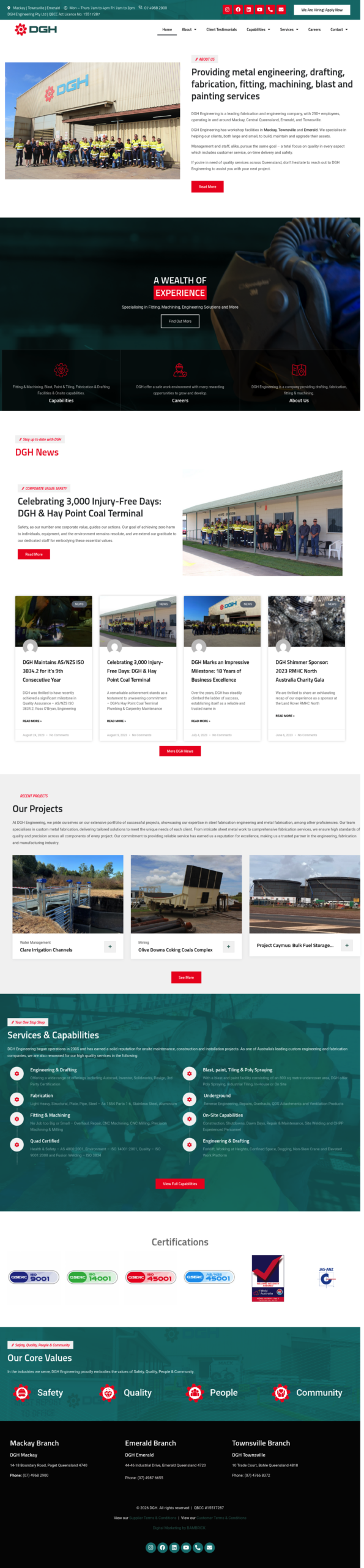
You have built real regional capability with workshops in Mackay, Townsville and Emerald, a QBCC licence and a team of 250+ people. Yet the site is attracting only about 5 visits per month, has a very small keyword footprint and just 14 Google reviews at 3.9, so procurement officers and site managers will not see the scale you have when shortlisting suppliers. That mismatch is costing visibility on the industrial projects you could win across Central and North Queensland.
Your online reputation
3.9
Google star rating
14
Verified reviews
Medium
Reputation strength
Google Business Profile
Your online presence — what the data reveals
AI Visibility
Low
Authority Score
6
out of 100
Organic traffic
5
est. monthly visits
Traffic Trend
-29
%
past 12 months
Organic Keywords
7
ranking terms
Keyword Trend
+0
%
past 12 months
Backlinks
278
total
Paid traffic
0
0 paid campaigns
Digital maturity
Level 2
out of 5
Your hardest to copy assets are your regional footprint and your operating scale: three workshops across Mackay, Townsville and Emerald and a workforce of 250+ people. You also deliver specialised, capital-intensive work such as pressure vessels, shutdown services and heavy machining that competitors cannot replicate overnight. If your online presence clearly communicated those assets, you could turn local procurement searches and site manager enquiries into predictable project leads.
How your website scores
TECH STACK
UX OBSERVATIONS
The site explains capability at length but fails to structure decision-making for procurement — buyers are not offered a clear next step (quote, capability pack, call booking) so enquiry friction rises.
Trust signals exist (certifications, team photo, multi-site addresses) but are visually de-emphasised and fragmented, which reduces perceived authority and weakens justification for awarding larger, higher-value projects.
The visual hierarchy privileges corporate content and news over commercial CTAs; this distracts buyers and wastes the operational credibility the business needs to convert regional scale into predictable inbound projects.
Having 250+ staff and multi-site capacity but only around 5 organic visits per month and an authority score of 6 means most regional buyers simply cannot find or assess you online. A 3.9 Google rating from 14 reviews gives some social proof, but it is too small to influence shortlist decisions at scale. The result is an unreliable inbound pipeline and missed contracts despite genuine delivery capacity.
The three gaps holding you back
What's possible when these gaps are closed
Lead with the upside: your 250+ staff and three workshops can be presented as a single regional capability that procurement and site managers recognise immediately. By clearly showcasing multi-site capacity and QBCC accreditation, a focused campaign could lift visibility from about 5 visits a month to a steady stream of qualified enquiries from nearby projects.
Lead with the upside: simplify service messaging so each sector sees a clear fit within seconds. Rework service pages into sector-specific pages and case studies for pressure vessels, shutdowns and onsite machining so buyers can shortlist you faster rather than sifting through a long, mixed list of services; that clarity shortens sales cycles and increases shortlist conversion.
Lead with the upside: add quantified case studies, sector outcomes and visible accreditations to turn casual visitors into qualified leads. With 88 referring domains and existing backlinks in place, proving outcomes and adding structured evidence will lift your authority and dramatically improve the rate at which site visitors become project enquiries.
This report was prepared by Redfox Digital using publicly available SEO, UX and reputation data.