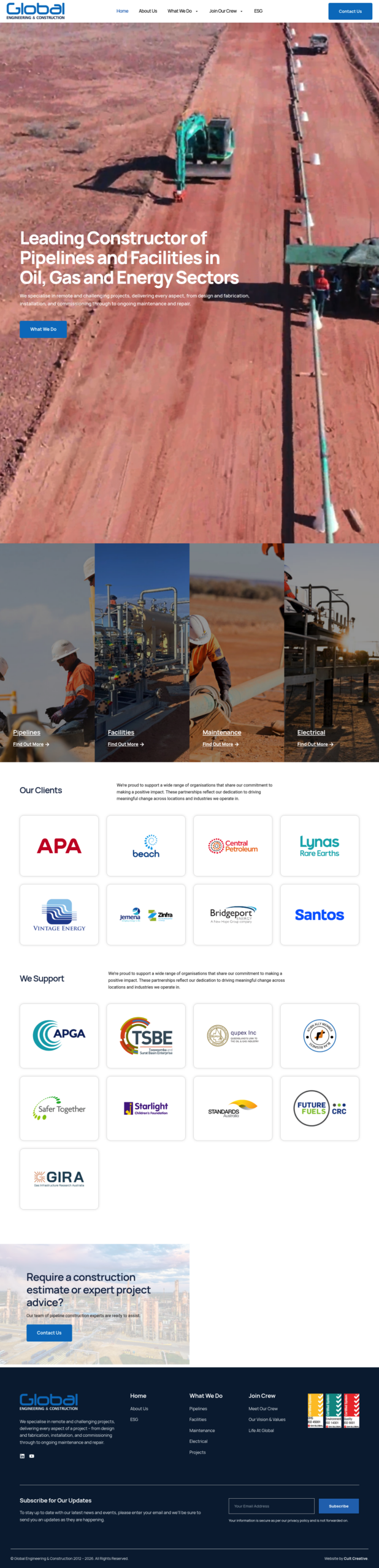
Global Engineering and Construction has built real field capability: ten years of pipeline, facilities, maintenance and electrical projects across remote Australian basins, supported by offices in Brisbane and Kingaroy. That on-the-ground reputation and operational scale are not showing up where procurement teams decide, because project-level proof and clear service boundaries are missing from decision pages. As a result, technical buyers and tier 1 contractors are overlooking opportunities that the company is already equipped to win.
Your online reputation
Google star rating
Verified reviews
Medium
Reputation strength
Google Business Profile
Your online presence — what the data reveals
AI Visibility
Low
Authority Score
9
out of 100
Organic traffic
196
est. monthly visits
Traffic Trend
-30
%
past 12 months
Organic Keywords
39
ranking terms
Keyword Trend
-13
%
past 12 months
Backlinks
329
total
Paid traffic
0
0 paid campaigns
Digital maturity
Level 2
out of 5
You have two assets that are genuinely hard to copy: a decade of remote construction experience across Australian basins and physical logistics support with offices in Brisbane and Kingaroy. Those assets mean you already meet the practical demands of large oil, gas and energy projects that many competitors cannot match. If the digital presence catches up, those strengths could turn into more direct enquiries and more frequent shortlist placements.
How your website scores
TECH STACK
UX OBSERVATIONS
Primary CTA is generic and tactical rather than commercial; consequence: buyers with budgets or live tenders lack a direct path to request a quote or submit project details, increasing drop-off.
Client and membership logos are displayed without project metrics, case studies or safety performance; consequence: procurement teams will not find the project-level proof required for shortlisting.
Visual identity and information hierarchy are competent but visually undifferentiated and low on authoritative emphasis; consequence: the site under-signals the maturity and scale implied by the business, diluting trust on first impression.
Organic visibility has slipped from about 283 visits per month a year ago to roughly 198 today, while authority sits at a low 9 and keywords have also declined. That decline is not just a numbers problem: it means fewer procurement contacts are finding the evidence they need to shortlist Global, and steady organic enquiries are being lost. With project proof absent from the right pages, the decade of field work is not translating into commercial opportunities.
The three gaps holding you back
What's possible when these gaps are closed
Publish clear, project-level case studies that surface client names, scope and quantified outcomes drawn from the decade of work so buyers see real evidence where they decide. Showing 3 to 5 flagship projects from the basins plus logistics details about Brisbane and Kingaroy will make it much easier for procurement teams to validate capability without a long back-and-forth.
Convert shallow service pages into short decision documents that outline scope examples, capability boundaries and outcome metrics so technical buyers can self-qualify. That makes it far more likely the roughly 198 monthly visitors will turn into meaningful enquiries rather than bounce because they cannot quickly assess fit.
Addressing proof and building targeted content will stop the slide from 283 to 198 monthly visits and rebuild authority from an AS of 9 by earning more relevant keywords and referrals. Restoring that visibility will return steady organic enquiries and external validation that supports shortlist inclusion.
This report was prepared by Redfox Digital using publicly available SEO, UX and reputation data.