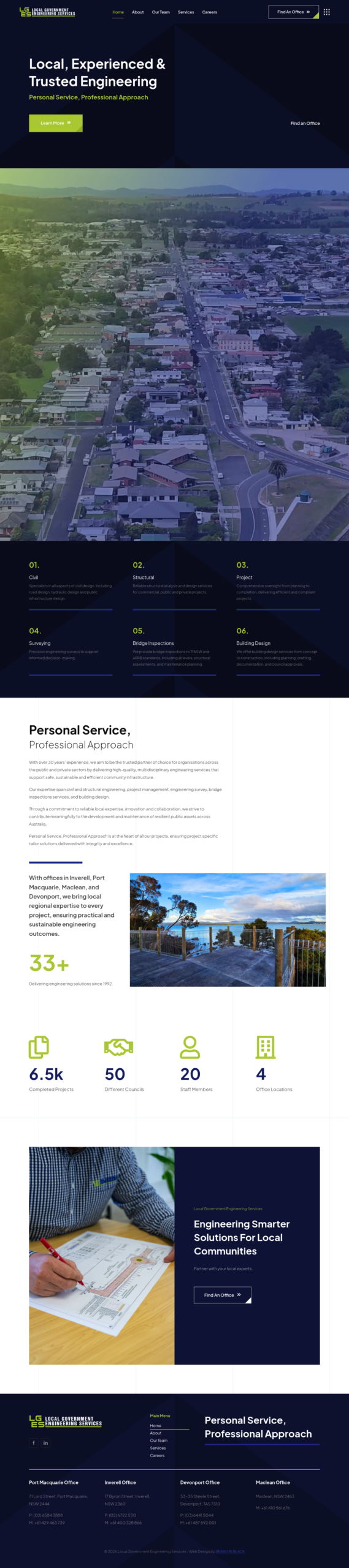
Legs has built a strong regional reputation over 30+ years and lists roughly 6,000 projects across Tasmania and regional New South Wales, covering civil and structural engineering, surveying, bridge inspections and project management. That history gives clear credibility with local councils and private clients, but the website does not surface the decision-focused evidence procurement teams expect. As a result, shortlisted public sector opportunities and tender-stage enquiries are being lost to competitors who present case studies, client logos and capability documents more clearly.
Your online reputation
Google star rating
Verified reviews
High
Reputation strength
Google Business Profile
View on Google Maps →
Your online presence — what the data reveals
AI Visibility
Low
Authority Score
2
out of 100
Organic traffic
0
est. monthly visits
Traffic Trend
-100
%
past 12 months
Organic Keywords
8
ranking terms
Keyword Trend
-53
%
past 12 months
Backlinks
130
total
Paid traffic
0
0 paid campaigns
Digital maturity
Level 1
out of 5
Legs’ two hardest-to-replicate assets are a 30+ year continuous regional presence and a project record of around 6,000 jobs across Tasmania and regional NSW. Those long-standing relationships and depth of local public‑sector experience mean, if the digital presence catches up, Legs could turn that credibility into procurement-ready enquiries by surfacing project evidence, downloadable capability packs and direct procurement contacts on the site.
How your website scores
TECH STACK
UX OBSERVATIONS
Trust signals are present but not carrying enough visual authority to match the consultancy’s implied experience; absence of case studies, client logos or certifications is likely to prevent procurement teams from qualifying the firm quickly.
The content explains services but fails to structure decision‑making for council buyers; outcome metrics and project evidence are not surfaced, increasing friction in the evaluation and procurement cycle.
Primary CTAs direct users to find an office or read more rather than to evidence‑based conversion points (capability pack, projects, procurement contacts), which dilutes conversion intent and reduces the volume of qualified enquiries.
With an authority score of 2, only eight organic keywords and a national search rank near 4 million, passive discovery at the tender stage is effectively zero. That means councils and procurement teams rarely find or shortlist Legs online, so high-value public sector work is not flowing from the firm’s long project history.
The three gaps holding you back
What's possible when these gaps are closed
Convert the 30+ years and roughly 6,000 projects into decision-ready case studies, client logos, certifications and downloadable capability documents that procurement teams expect to see. Making that evidence easy to find and download turns hard-won credibility into tangible proof reviewers can rely on during shortlisting.
Replace location-first CTAs like ‘Find an Office’ and ‘Read More’ with primary actions that deliver capability packs, project PDFs and direct procurement contacts. That change channels visitors who are in tender or procurement mode into high-value, trackable enquiries rather than low-value location questions.
Use the existing backlink base of about 130 links from 65 referring domains and focused content to lift organic keyword coverage beyond the current eight terms and improve the authority score. Even modest gains in keywords and authority will increase tender-stage discovery from councils and lift passive, lower-effort opportunities.
This report was prepared by Redfox Digital using publicly available SEO, UX and reputation data.