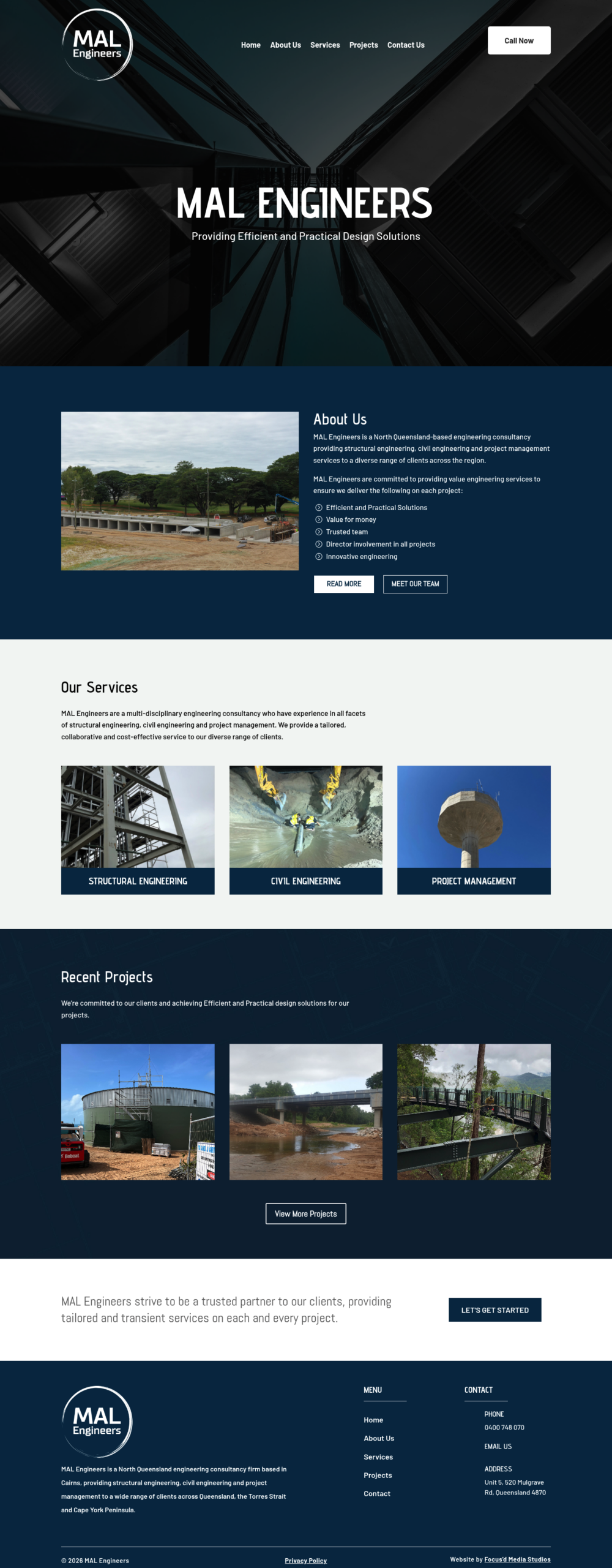
MAL Engineers has clear regional reach and technical standing, with an RPEQ director and named projects such as Torres Strait Reservoir Remedial Works and Kirks Bridge supporting work across North Queensland, the Torres Strait and Cape York Peninsula. Despite that credibility, those assets are not presented as the kind of decision-ready evidence procurement teams expect, so many council, government and private opportunities are being lost at the tender stage. This review focused on how those specific projects and leadership credentials are showing up online and where short-term fixes can improve tender outcomes.
Your online reputation
5
Google star rating
1
Verified reviews
Medium
Reputation strength
Google Business Profile
Your online presence — what the data reveals
AI Visibility
Low
Authority Score
7
out of 100
Organic traffic
14
est. monthly visits
Traffic Trend
+0
%
past 12 months
Organic Keywords
22
ranking terms
Keyword Trend
+110
%
past 12 months
Backlinks
106
total
Paid traffic
0
0 paid campaigns
Digital maturity
Level 2
out of 5
You have two hard-to-replicate assets: an RPEQ-registered director backing every project and two named regional projects that prove regional delivery capability. You also operate across three distinct regions of North Queensland, giving clear geographic reach that competitors based elsewhere would struggle to match. If those assets are translated into tender-ready case studies and clear qualification paths on the site, they could turn credibility into repeat shortlist placements for council and government tenders.
How your website scores
TECH STACK
UX OBSERVATIONS
Trust signals are under-signalled: project images and generic copy exist but absence of client names, project outcomes, certifications or quantified metrics is diluting credibility for government and tender teams.
Service messaging is clear but not decision-ready: capabilities are listed without sector-specific pathways, qualification criteria or proof points, which fails to structure procurement-level decision-making.
Conversion intent is fragmented: multiple low-priority CTAs and no obvious primary action or lead-qualification mechanism (form, tender pack, sector enquiry) are causing qualified prospects to stall rather than convert.
With just 14 organic visits a month and only one Google review, your online reach and visible social proof are too small to influence procurement teams. Although keyword counts have risen to 21 from 10, the authority score of 7 and a national search rank around 1.4 million show those gains are not yet generating tender-stage enquiries. In short, the credibility exists but the website and lead systems are not capturing or converting the right opportunities.
The three gaps holding you back
What's possible when these gaps are closed
Package Torres Strait Reservoir Remedial Works and Kirks Bridge as two detailed, sector-focused case studies that show scope, outcomes and client references. Publishing 2 to 4 tender-ready case studies that include quantified outcomes will give procurement teams the short evidence trail they need to shortlist MAL Engineers. That evidence can be the difference between an initial call and an invitation to tender.
Make bridges, water infrastructure and project management the three priority offerings and show typical deliverables and outcomes for each. Rewriting service pages to describe typical project size, timelines and common deliverables will let buyers recognise fit within seconds rather than hunting through a long list. Clear prioritisation builds faster recognition from councils and government teams who shortlist suppliers by fit.
Add simple qualification steps and tender-ready assets on project pages, such as brief scope summaries, deliverable checklists and a short form for procurement details. With only 14 visits a month, converting even one extra qualified enquiry per month would materially improve your pipeline and let the RPEQ director engage earlier. Automated follow-up and a downloadable scope template will turn passive traffic into actionable tender leads.
This report was prepared by Redfox Digital using publicly available SEO, UX and reputation data.