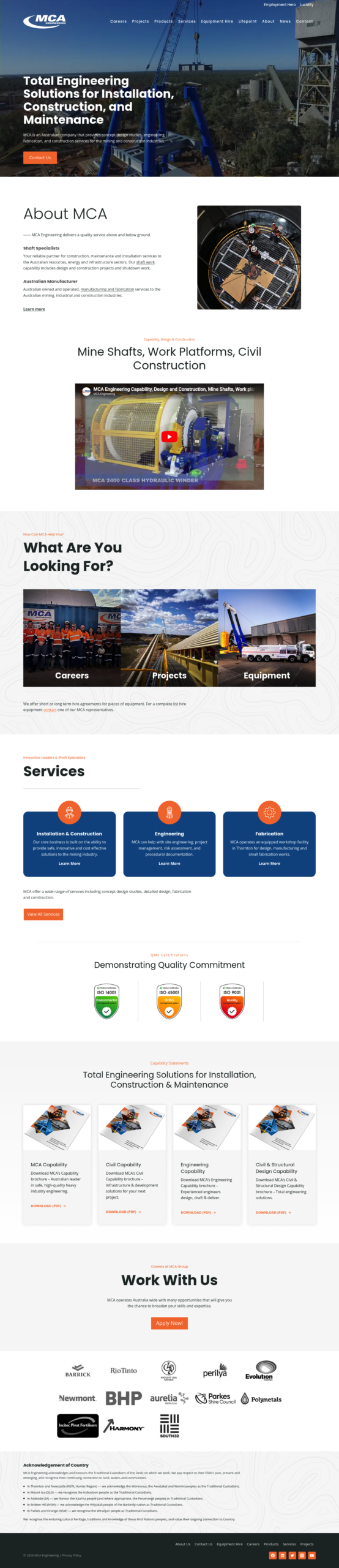
MCA has built real operational scale and sector experience: around 180 staff, offices in South Australia, New South Wales and Queensland, and a combined six decades of engineering work for mining and infrastructure clients. That credibility is not showing where commercial buyers decide, with the site offering capability PDFs, few client outcomes and a small Google review footprint (4.2 from 5 reviews across 5 reviews). As a result, enquiries and tender shortlists for high-value shaft, fabrication and installation work are being lost to better-evidenced competitors.
Your online reputation
4.2
Google star rating
5
Verified reviews
Medium
Reputation strength
Google Business Profile
Your online presence — what the data reveals
AI Visibility
Low
Authority Score
10
out of 100
Organic traffic
365
est. monthly visits
Traffic Trend
+14
%
past 12 months
Organic Keywords
121
ranking terms
Keyword Trend
-3
%
past 12 months
Backlinks
786
total
Paid traffic
0
0 paid campaigns
Digital maturity
Level 2
out of 5
The strongest assets MCA has are its operational scale and deep sector experience: roughly 180 staff and offices across three states, plus a combined six decades of industry expertise. Those are hard for a local competitor to replicate quickly. If the website and proof set were aligned to that scale, MCA could turn reputation into a steady pipeline of tender-ready enquiries and stronger shortlist placement.
How your website scores
TECH STACK
UX OBSERVATIONS
Trust signals are present but not carrying enough visual authority to match the credibility the business needs, reducing the likelihood of inclusion on tender shortlists.
Hero messaging is broad and unfocused, failing to confirm fit quickly for a technical buyer and increasing early-stage bounce from procurement stakeholders.
Conversion paths are fragmented and low-priority (downloads, generic Contact and Apply CTAs), which fails to structure decision-making and weakens lead quality for commercial enquiries.
With about 365 organic visits per month and roughly 121 ranking keywords, the site is not driving the volume or keyword reach needed to appear in procurement searches for technical projects. Despite a solid on-paper capability and 180 staff, the small review footprint and limited visible project evidence mean buyers do not see the outcomes that shortlists require. In practice this reduces inbound enquiries for high-value tenders and extends procurement timelines at the point where MCA should be strongest.
The three gaps holding you back
What's possible when these gaps are closed
Showcasing a handful of detailed project case studies that highlight outcomes and team roles will convert reputation into evidence. Use the reality of 180 staff and six decades of experience to build 6 to 10 buyer-ready case pages that procurement panels can read in minutes.
Simplify the services structure into decision-focused pages so a buyer can move from problem to proposal quickly instead of wading through capability text. With current traffic at about 365 visits a month, clearer paths and focused calls to action can turn more of those visits into direct enquiries and tender invitations.
Improve keyword relevance and on-page proof to expand beyond the current ~121 keywords and 365 visits per month, using the existing backlink base of 211 referring domains to amplify gains. Targeted technical content and project narratives can raise visibility for procurement searches and produce a measurable uptick in inbound tender-ready leads.
This report was prepared by Redfox Digital using publicly available SEO, UX and reputation data.