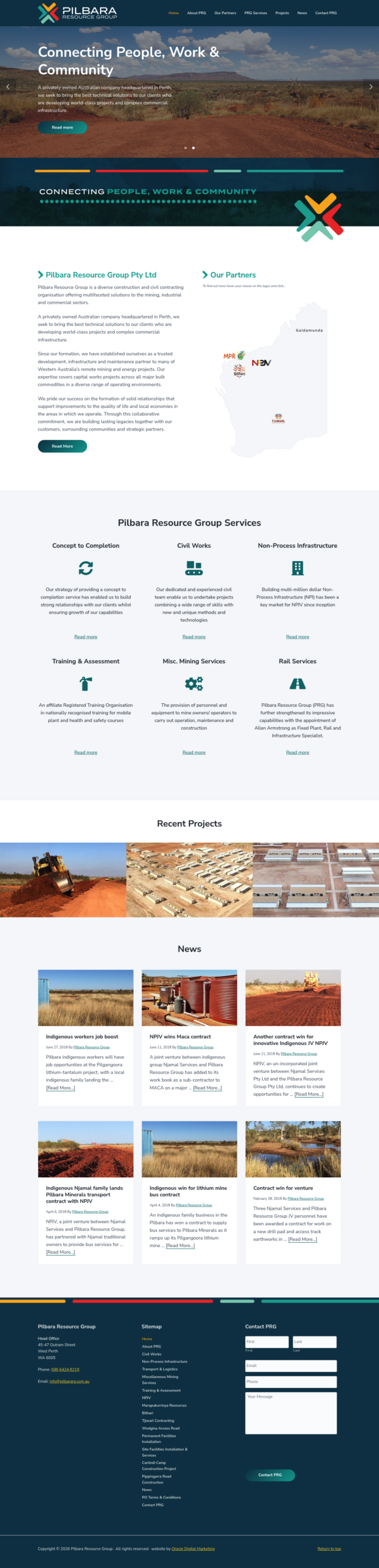
Pilbara Resource Group has built hard-to-replicate on-the-ground capability and marquee project experience from its Perth base, including work on the Wodgina Access Road and partnerships with NPJV, Bithari, Marapikurrinya and Tjiwarl Contracting. That credibility is not translating into qualified commercial enquiries because the site and public signals do not present procurement-ready proof or clear decision information. The result is missed shortlisting and tender opportunities with larger mining operators and contractors across Western Australia.
Your online reputation
3.4
Google star rating
5
Verified reviews
Medium
Reputation strength
Google Business Profile
Your online presence — what the data reveals
AI Visibility
Low
Authority Score
10
out of 100
Organic traffic
317
est. monthly visits
Traffic Trend
+134
%
past 12 months
Organic Keywords
126
ranking terms
Keyword Trend
+14
%
past 12 months
Backlinks
118
total
Paid traffic
0
0 paid campaigns
Digital maturity
Level 1
out of 5
Your strongest assets are real and scarce: four named partner relationships (NPJV, Bithari, Marapikurrinya and Tjiwarl) and hands-on delivery on marquee projects such as the Wodgina Access Road. You also run logistics and site facilities work across remote WA that competitors cannot easily copy. If your online presence starts to show procurement-ready evidence, those partnerships and site capabilities can become the proof that wins shortlisting and larger tenders.
How your website scores
TECH STACK
UX OBSERVATIONS
Hero tagline and generic imagery prioritise brand sentiment over buyer action; consequence: procurement stakeholders are not given a clear, fast route to validate capability or request tender information.
Trust cues are present but under‑signalling: partner logos, news and a projects section exist but lack prominent project metrics, certifications or case summaries; consequence: the site fails to convert reputation into procurement confidence.
Visual hierarchy flattens decision making with numerous 'Read more' links and a low‑priority contact form; consequence: conversion intent is weakened because high‑value actions (contact, download capability pack, request quote) are not clearly surfaced or differentiated.
With roughly 330 organic visits a month and an authority score of 10, procurement teams are unlikely to find or trust online evidence when compiling shortlists. A 3.4 Google rating from five reviews and sparse case detail force buyers to phone for verification, so PRG is often excluded from larger, documentation-driven tender processes. The net effect is lost shortlisting and an over-reliance on existing contacts rather than a steady pipeline of qualified commercial enquiries.
The three gaps holding you back
What's possible when these gaps are closed
Turn the Wodgina Access Road and NPJV partnerships into two to three detailed case studies that show scope, outcomes and measured results. Those documents let procurement teams verify past performance quickly and move PRG onto more shortlists without lengthy phone checks.
Publish clear, scoped deliverables for core services such as civil works, permanent facilities and site services so buyers can assess fit without a call. Adding safety, accreditation and typical contract terms will shorten qualification time and raise the value of inbound enquiries.
Increase referring domains from the current 63 and build on 118 backlinks to lift monthly organic visits above the present ~330. A focused content and backlink plan aimed at 100 plus referring domains and sector keywords can turn the current traffic growth into a predictable pipeline of tender opportunities.
This report was prepared by Redfox Digital using publicly available SEO, UX and reputation data.