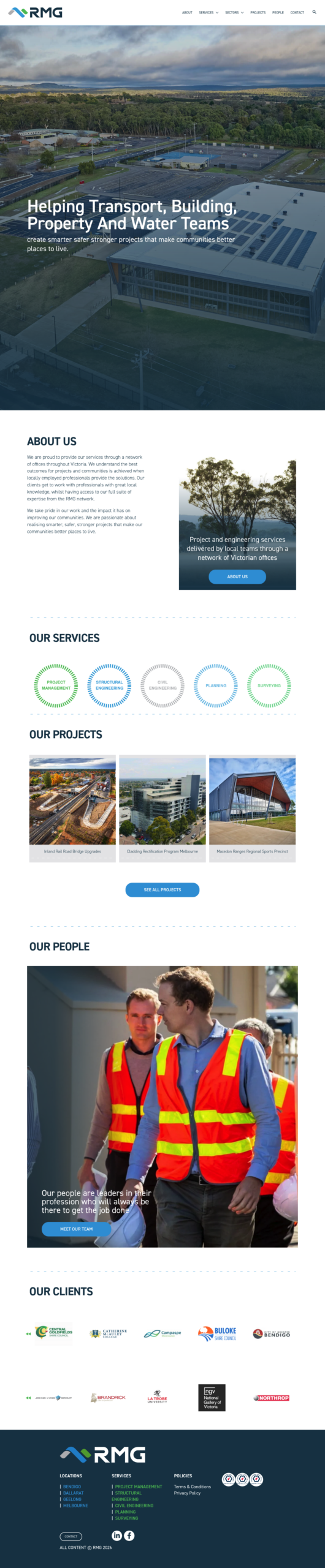
RMG has built real regional credibility from its Bendigo base and a network of local offices serving Grampians, Loddon Mallee, Hume and Barwon South West, and it delivers project and engineering work across transport, buildings, property and water. That credibility and ISO accreditation are not translating into predictable, qualified online enquiries because the site and commercial systems do not present measurable project outcomes or a clear client intake path. As a result, government and private sector briefs that check online proof are being lost despite clear local capability.
Your online reputation
5
Google star rating
3
Verified reviews
High
Reputation strength
Google Business Profile
Your online presence — what the data reveals
AI Visibility
Low
Authority Score
16
out of 100
Organic traffic
584
est. monthly visits
Traffic Trend
+113
%
past 12 months
Organic Keywords
55
ranking terms
Keyword Trend
+31
%
past 12 months
Backlinks
105
total
Paid traffic
0
0 paid campaigns
Digital maturity
Level 2
out of 5
You have an ISO-accredited network of local offices across four Victorian regions that is hard for metropolitan competitors to replicate. A perfect 5.0 Google rating from three reviewers and a backlink footprint of 105 links from 60 referring domains give RMG a credible starting point online. If the digital presence catches up, those assets could win more government and private briefs by proving local capability right where procurement teams look.
How your website scores
TECH STACK
UX OBSERVATIONS
The hero message is generic and outcome-free, so buyers will not get a clear reason to prioritise RMG over competitors and will not progress to contact.
Trust signals exist but are visually de-emphasised and uncontextualised, so procurement decision-makers cannot quickly verify experience and that increases qualification friction.
There is no dominant conversion path or clear primary CTA, so the site funnels visitors into passive browsing instead of creating predictable, qualified enquiries.
With only about 593 monthly organic visits and an authority score of 16, procurement teams will see thin online proof and are likely to shortlist competitors with clearer measurable outcomes. Because service pages spread many technical offerings and there is no visible intake route, much of that modest traffic and referral strength will not convert into scoped, qualified briefs.
The three gaps holding you back
What's possible when these gaps are closed
Turn your ISO accreditation and local project work into short, sector-specific case studies that show outcomes, timelines and measurable benefits for transport, buildings, property and water projects. Use the current 5.0 Google rating from three reviewers and the 60 referring domains to create pages procurement officers recognise when they check credentials.
Present a single, obvious entry point for each sector with a sample scope and next steps so clients do not have to guess which service fits their brief. That clarity will make better use of the roughly 59 keywords and the recent traffic lift from about 278 to 593 monthly visits, turning casual visitors into qualified enquiries.
Introduce a visible intake route with a few qualification questions and simple CRM handover so enquiries become scoped proposals rather than generic messages. Even small automation and follow-up steps will let you convert a higher share of the current 593 monthly visits and leverage your 105 backlinks into priced briefs.
This report was prepared by Redfox Digital using publicly available SEO, UX and reputation data.