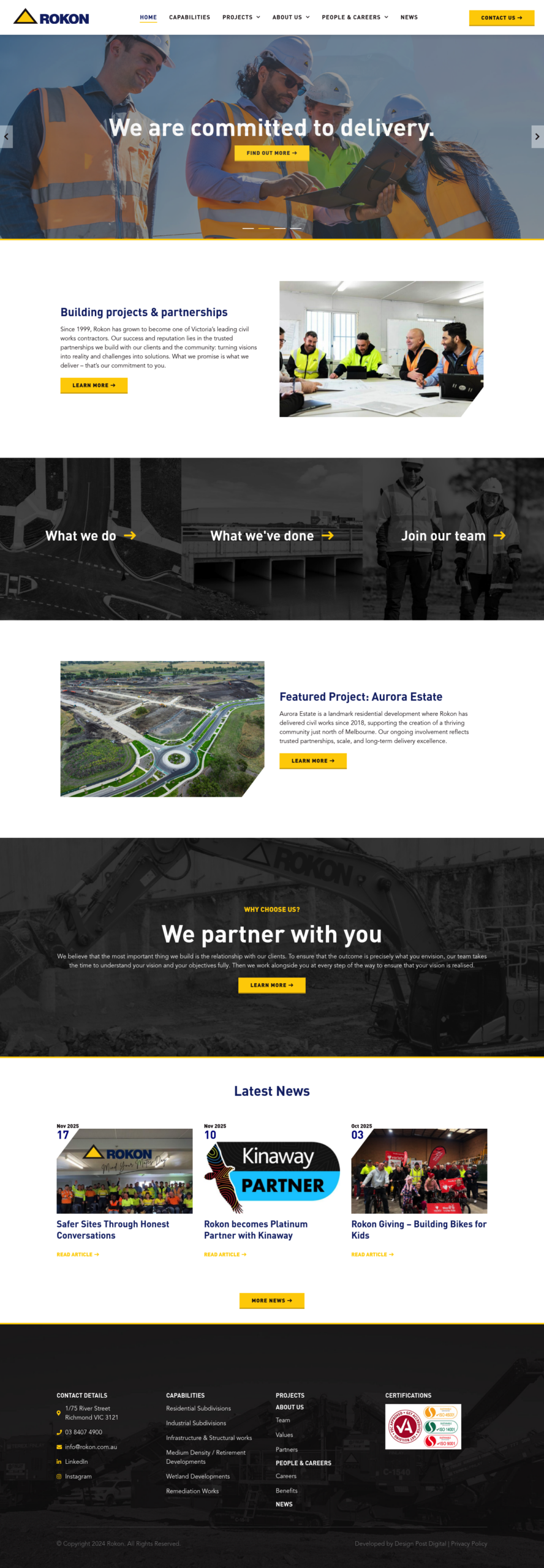
Rokon has built real credibility in Melbourne and across metropolitan Victoria since 1999, with a project portfolio that includes subdivision work such as Aurora Estate and long-running relationships with local developers and councils. That established capability is not presented as measurable outcomes or sector-specific proof where decision-makers land, so developers and council procurement teams are being lost to competitors with clearer, outcome-focused case studies. Fixing how those projects and outcomes are shown would stop strong offline reputation evaporating at the first digital hurdle.
Your online reputation
3.3
Google star rating
23
Verified reviews
Medium
Reputation strength
Google Business Profile
Your online presence — what the data reveals
AI Visibility
Low
Authority Score
15
out of 100
Organic traffic
818
est. monthly visits
Traffic Trend
+7
%
past 12 months
Organic Keywords
97
ranking terms
Keyword Trend
-22
%
past 12 months
Backlinks
479
total
Paid traffic
0
0 paid campaigns
Digital maturity
Level 2
out of 5
Rokon’s two strongest, hard-to-replicate assets are its long operating history since 1999 (27 years) and an on-the-ground project footprint across metropolitan Victoria, including work on Aurora Estate. Those local relationships and proven delivery capability are not something a new entrant can replicate overnight. If the website begins to showcase measurable project outcomes and sector-specific case studies in the right places, that 27-year track record could start delivering a steadier flow of higher-value enquiries.
How your website scores
TECH STACK
UX OBSERVATIONS
Headline and hero imagery communicate generic commitment rather than project outcomes; this reduces rapid qualification by developers and procurement teams and increases time-to-contact.
Certifications and contact details exist but are visually deprioritised; absence of prominent client logos, quantified project metrics or case snapshots under-signals capacity for larger, risk-averse buyers and dilutes perceived authority.
Navigation and CTAs scatter attention with multiple 'learn more' routes and no clear buyer journey (e.g. project types, case study highlights, request-a-quote); this fails to structure decision-making and weakens conversion efficiency for high-value leads.
With roughly 800 monthly organic visits, about 100 keywords and an authority score in the mid-teens, most inbound interest is intermittent and mixed in quality rather than a steady stream of tender-ready enquiries. Combined with a 3.3 Google rating from 23 reviews and landing pages that do not surface measurable outcomes, developers and councils will continue to shortlist competitors who present clearer, sector-specific proof.
The three gaps holding you back
What's possible when these gaps are closed
Put measurable outcomes front and centre to turn reputation into shortlist wins; highlight timelines, budget performance and client names for projects like Aurora Estate to build immediate credibility. Showing those figures where buyers land will shorten evaluation time and increase the chance Rokon is invited into tender processes.
Rework the Capabilities pages so each service explains scope, typical deliverables and a clear engagement timeline, removing the need for prospects to guess what you do. That clarity will convert a higher share of the roughly 700–800 monthly visitors into meaningful enquiries rather than sending them to competitors with more specific offers.
Lift local visibility and sentiment by prioritising sector keywords and improving local reviews to make inbound leads more consistent and higher quality; go after clear wins that move authority above the mid-teens and strengthen the Google Business Profile rating. As organic traction and local confidence grow, Rokon can turn intermittent enquiries into a pipeline of tender-ready opportunities with measurable value.
This report was prepared by Redfox Digital using publicly available SEO, UX and reputation data.