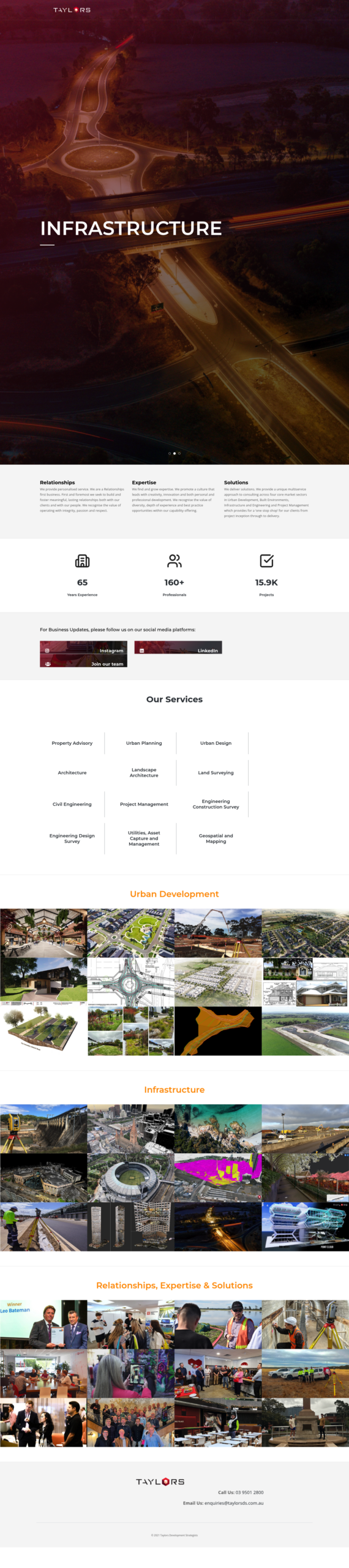
Taylors has built rare scale and longevity: 65 years in practice, more than 160 professionals and a portfolio of about 15,900 projects across Melbourne and Victoria, serving developers, councils and public agencies. That credibility is visible, but it is presented as disconnected claims rather than shortlist-ready evidence, so procurement teams and major developers are not finding the proof they need. As a result, the firm is losing large-project briefs and strategic engagements it is otherwise well placed to win.
Your online reputation
4.6
Google star rating
10
Verified reviews
Medium
Reputation strength
Google Business Profile
Your online presence — what the data reveals
AI Visibility
Low
Authority Score
19
out of 100
Organic traffic
97
est. monthly visits
Traffic Trend
+115
%
past 12 months
Organic Keywords
18
ranking terms
Keyword Trend
-70
%
past 12 months
Backlinks
1497
total
Paid traffic
0
0 paid campaigns
Digital maturity
Level 1
out of 5
Your hardest-to-copy assets are clear: 65 years of continuous practice and a multidisciplinary team of over 160 people, supported by roughly 15,900 completed projects and a 4.6 Google rating from ten reviewers. Those assets create an advantage that competitors cannot quickly match. If the digital presence turns those strengths into obvious, shortlist-ready evidence, Taylors can convert reputation into more large-project briefs from developers, councils and agencies.
How your website scores
TECH STACK
UX OBSERVATIONS
Hero leads with atmosphere not argument: a single-word sector headline and no primary CTA leave developer and council buyers unclear on what to do next, reducing immediate engagement and click-throughs.
Trust signals are present but devalued: years, team size and project count are visually small and disconnected from project evidence or client logos, under-signalling credibility for large procurements and weakening shortlist inclusion.
Breadth without structure: the services grid and image mosaics show capability but fail to prioritise or route decision-making for complex briefs, creating friction that lowers the likelihood of qualified enquiries.
With only about 97 organic visits a month and a national search rank near 683,349, procurement teams and developers are unlikely to find Taylors when searching for suppliers. The fall from 46 ranking keywords a year ago to 14 today further reduces the chances of being discovered for the right briefs. The practical outcome is a thinner pipeline of procurement conversations and missed opportunities on multi-million dollar projects.
The three gaps holding you back
What's possible when these gaps are closed
Present a curated set of 8 to 12 commercial case studies drawn from the 15,900-project archive that match the typical briefs of developers, councils and public agencies. Each case should emphasise outcomes, partners, procurement value and measurable impact so decision makers can see the fit within seconds.
Reframe the services grid into three clear routes for urban development, infrastructure and built-environment strategy, signalling priority and scale for complex briefs. Show typical project sizes and procurement triggers so a buyer can self-identify and move from curiosity to a qualified conversation in under 15 seconds on the page.
Replace an atmospheric hero with a single primary call to action that leads straight to shortlist evidence or a procurement contact, removing friction for busy decision makers. A focused CTA plus visible proof points and the firm’s 4.6 Google rating and 160+ staff will turn reputation into more actionable leads for large briefs.
This report was prepared by Redfox Digital using publicly available SEO, UX and reputation data.