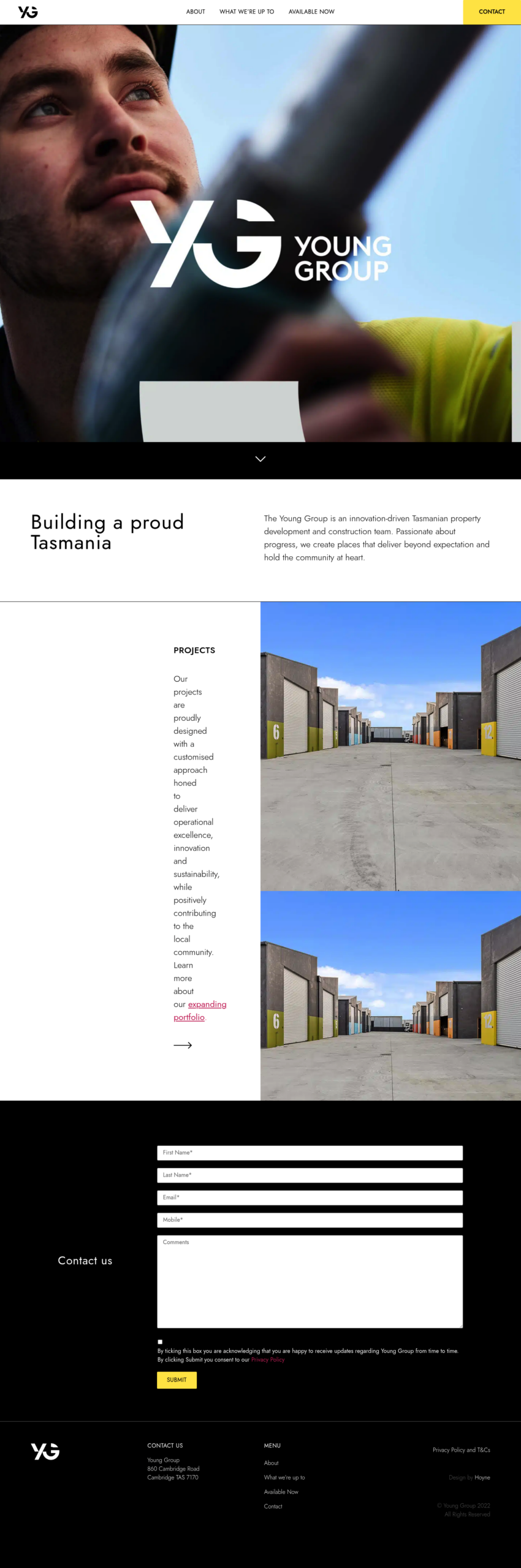
Theyg has built real local credibility: a family-owned, diversified property business founded in 2008 with a clear focus on Tasmanian projects and community outcomes, and an About page that asserts long-standing capability and breadth. That offline reputation is not translating online because the site shows no project case studies, repeats the same About copy across Services, and has a tiny search footprint. As a result, investor, tenant and council opportunities that rely on online verification are being lost.
Your online reputation
Google star rating
Verified reviews
Medium
Reputation strength
Google Business Profile
View on Google Maps →
Your online presence — what the data reveals
AI Visibility
Low
Authority Score
7
out of 100
Organic traffic
5
est. monthly visits
Traffic Trend
-90
%
past 12 months
Organic Keywords
25
ranking terms
Keyword Trend
+178
%
past 12 months
Backlinks
56
total
Paid traffic
0
0 paid campaigns
Digital maturity
Level 2
out of 5
The good news is they already have two assets that are hard to copy: a family-owned, Tasmanian-first reputation built since 2008, and a genuine full-spectrum property capability across development, construction, management and leasing that speaks to multiple local buyer types. Those assets mean they do not need to invent credibility; with a website that channels enquiries clearly, those local relationships and projects can be turned into verifiable leads and partner enquiries.
How your website scores
TECH STACK
UX OBSERVATIONS
Undersignalling credibility: the hero treatment prioritises brand mark over contextual proof so visitors cannot quickly assess project scale or track record, which reduces trust and slows commercial decisions.
Lower lead yield due to weak conversion funnel: the primary contact is a small top-right button and the full contact form is buried low on the page, forcing high-intent visitors to hunt for the conversion path.
Unstructured decision flow increases drop-off: the homepage does not segment key audiences or prioritise actions for investors, tenants and councils, leaving visitors without a clear next step and losing momentum for partnership or leasing enquiries.
With organic visits down about 90% from roughly 41 to 4 monthly, most local searchers never see the business and so potential investors, tenants and councils do not get a chance to verify claims. An authority score of 7 and only 25 ranking keywords, despite a lift from 9, show the site has only a tiny, inconsistent reach. In short, solid offline capability exists but the current site is not capturing measurable online demand.
The three gaps holding you back
What's possible when these gaps are closed
Turn existing projects into concise case studies that prove outcomes and make enquiries natural. Use the 56 backlinks and 32 referring domains as a starting point to surface third party verification and convert sceptical investors into contactable leads.
Create separate, outcome-focused pages for development, construction, management and leasing so investors, tenants and councils can find the exact offer they need. The recent keyword growth from 9 to 25 shows searchers are finding some terms already; focused pages let you capture those searches with clearer calls to act.
Fix the site structure and on-page focus to stop the traffic bleed that cut visits from about 41 to 4 per month and to lift a low authority score of 7. Turning the small gains in keywords into consistent, local visibility will produce a steady trickle of verifiable enquiries rather than relying on offline reputation alone.
This report was prepared by Redfox Digital using publicly available SEO, UX and reputation data.