
Digital Growth Diagnostic
Heart and Vascular
- Anna-kate Buckell
The good news:
The strongest assets are a recognisable clinical footprint tied to Flinders Medical Centre and a pristine Google rating of 5.0 from four reviewers, backed by an established backlink profile of 288 links from 144 referring domains. Those facts are hard for a new competitor to copy quickly. If the website signals that authority where GPs and patients decide, those assets could convert into predictable GP referrals and more direct bookings.
A 20-minute review of these findings, your priorities and which changes are worth exploring.
What's already working for Heart and Vascular
Your reputation is a real asset
5
Google star rating
4
Verified reviews
High
Reputation strength
Google Business Profile
The first opportunity we’d explore
What closing theSE GAPS COULD looks like:
Turn clinical credibility into referral-ready content
Lead with clinician proof points where GPs and patients actually make decisions. Put senior clinician bios, Flinders Medical Centre links and research roles on service and referral pages and make the 5.0 Google rating from four reviewers visible; that makes it easier for referrers to find the evidence they need. Doing this would make better use of the existing monthly audience of about 852 visits and improve referral conversion.
Create clear GP and patient referral pathways online
Build two distinct flows: one for GPs with simple referral steps and a visible referrer portal link, and one for patients with plain booking steps and FAQs. The current services area reads like an undifferentiated catalogue; by organising care pathways you can turn more of the roughly 1,024 keywords you rank for into targeted leads. That separation will reduce friction and increase predictable bookings from both referrers and patients.
Signal hospital-grade authority through visual and UX upgrades
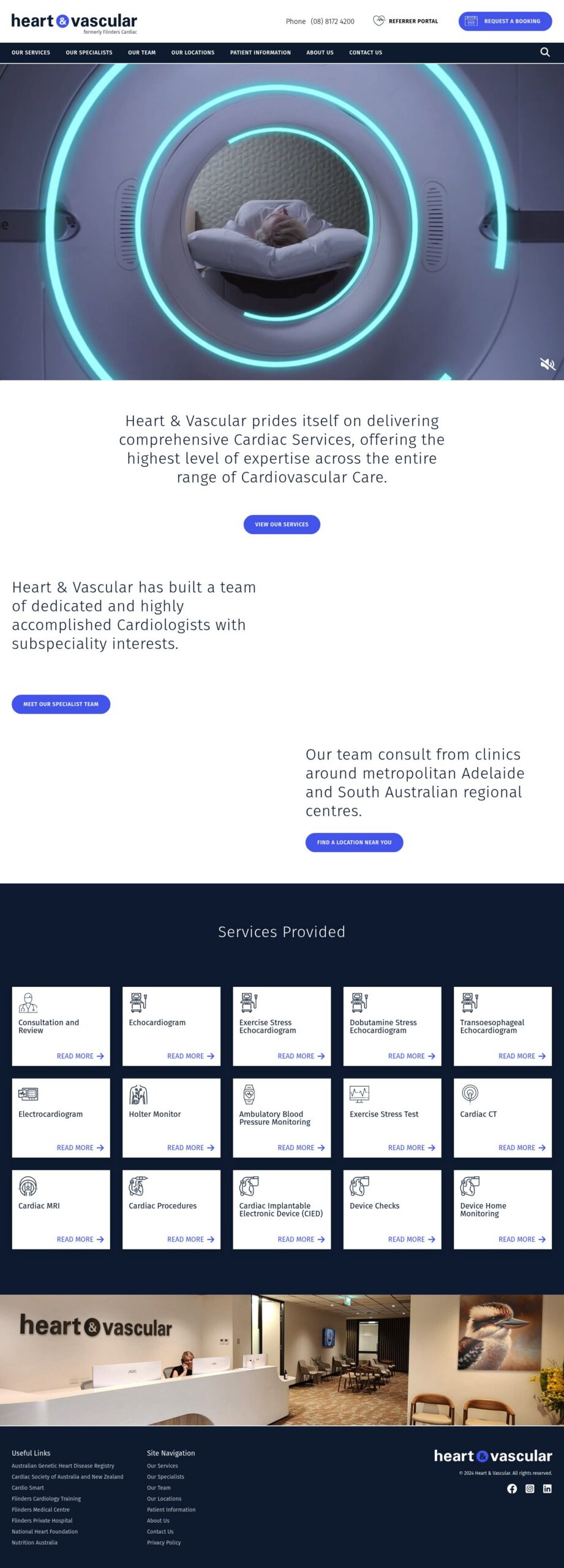
Improve hero imagery, typographic hierarchy and call to action buttons so the site reads as a hospital-affiliated specialist practice rather than a list of tests. These changes address low message, trust and conversion scores and back up the clinical proofs already present, helping to lift an authority score currently at 18 and improve a national rank stuck near 182,413. Clearer visual hierarchy and stronger calls to action will push more of the roughly 850 monthly visitors into booking or referral actions.
Not ready for a call yet?
Reply to Alanah with one question about this diagnostic and she’ll answer it directly. No pitch, no sequence.
Highly regarded cardiology team, but the website fails to turn credibility into referrals.
Heart and Vascular has built a specialist cardiology practice across Adelaide and regional South Australia, with clinician listings that reference Flinders Medical Centre and research roles. Despite a 5.0 Google rating from four reviews and an ongoing organic presence, that authority is not shown where GPs or patients make decisions. As a result, referral opportunities and direct patient bookings are being lost because the site does not guide referral or booking actions.
Heart and Vascular's online presence — what the data reveals
AI Visibility
Low
Authority Score
18
out of 100
Organic traffic
852
est. monthly visits
Traffic Trend
-12
%
past 12 months
Organic Keywords
1034
ranking terms
Keyword Trend
+76
%
past 12 months
Backlinks
288
total
Paid traffic
0
0 paid campaigns
Digital maturity
Level 1
out of 5
How your website scores
UX OBSERVATIONS
Headline and typography are under-signalling expertise, so visitors do not register specialist credibility quickly and GP referrers will lack immediate confidence to act.
Primary task hierarchy is weak and split across small, equal-weight CTAs, creating decision paralysis for GPs and patients and lowering the likelihood of a predictable referral or booking.
Comprehensive service tiles are presented with equal weight and visual clutter, preventing rapid route selection and extending time-to-contact which harms conversion velocity.
TECH STACK
Two more things we noticed
- Primary actions are unclear, so referrals and bookings are unpredictable. The hero, CTAs and task hierarchy are low-contrast and evenly weighted (UX conversion score 2), which fragments decision-making and lowers the likelihood of a GP or patient taking the predictable next step.
- Service presentation dilutes choice and slows contact. Services are listed as equal-weight tiles across many technical offerings, creating visual clutter and extending time-to-contact when patients or GPs need a fast route to the right specialty or booking option.

Ready to find out what stronger digital growth could look like
Book a free 20-minute call. We’ll map the gap between your commercial goals and digital capability, then design the system to close it.
This report was prepared by Redfox Digital using publicly available SEO, UX and reputation data.