
Digital Growth Diagnostic
Stirling Hospital
- Annette Nelson
- Chief Executive Officer/Director of Nursing
- Woodville, SA
The good news:
You have deep clinical breadth and formal accreditation across many specialities, with an established set of visiting surgeons and board members that would be hard for a new competitor to replicate. External recognition is already present: a 4.4 Google rating from 39 reviews and 316 backlinks from 149 referring domains show real-world referral and awareness. If the digital presence is aligned with that reputation, those assets can be turned into a dependable admissions channel and steadier GP referral flow.
A 20-minute review of these findings, your priorities and which changes are worth exploring.
What's already working for Stirling Hospital
Your reputation is a real asset
4.4
Google star rating
39
Verified reviews
High
Reputation strength
Google Business Profile
The first opportunity we’d explore
What closing theSE GAPS COULD looks like:
Turn clinical reputation into a referral admissions channel
Turn the hospital’s reputation into a referral-ready admissions channel by foregrounding surgeons, accreditation and outcomes at the exact moment GPs decide. Converting even a small share of the roughly 2,478 monthly organic visitors into booked pre-admission conversations would create a far more predictable elective admissions pipeline.
Present a premium, multi-speciality hospital image online
Refresh homepage imagery, service tiles and surgeon profiles so the site reads like a multi-speciality surgical hospital rather than a small clinic, increasing the chances GPs and higher-value patients shortlist Stirling. With 426 keywords and rising organic traffic, clearer premium messaging can capture a larger share of those visits into direct referral enquiries.
Create clear pathways for admissions and specialist proof
Build focused specialist landing pages with visible admission flows, priority calls to action and quick evidence of outcomes so referrers can find pathways in a few clicks. That clarity will shorten referral cycles and improve conversion of the current 2,478 monthly organic visits into scheduled elective admissions and pre-admission calls.
Not ready for a call yet?
Reply to Alanah with one question about this diagnostic and she’ll answer it directly. No pitch, no sequence.
Respected clinical reputation, but the site is losing GP referrals and elective admissions.
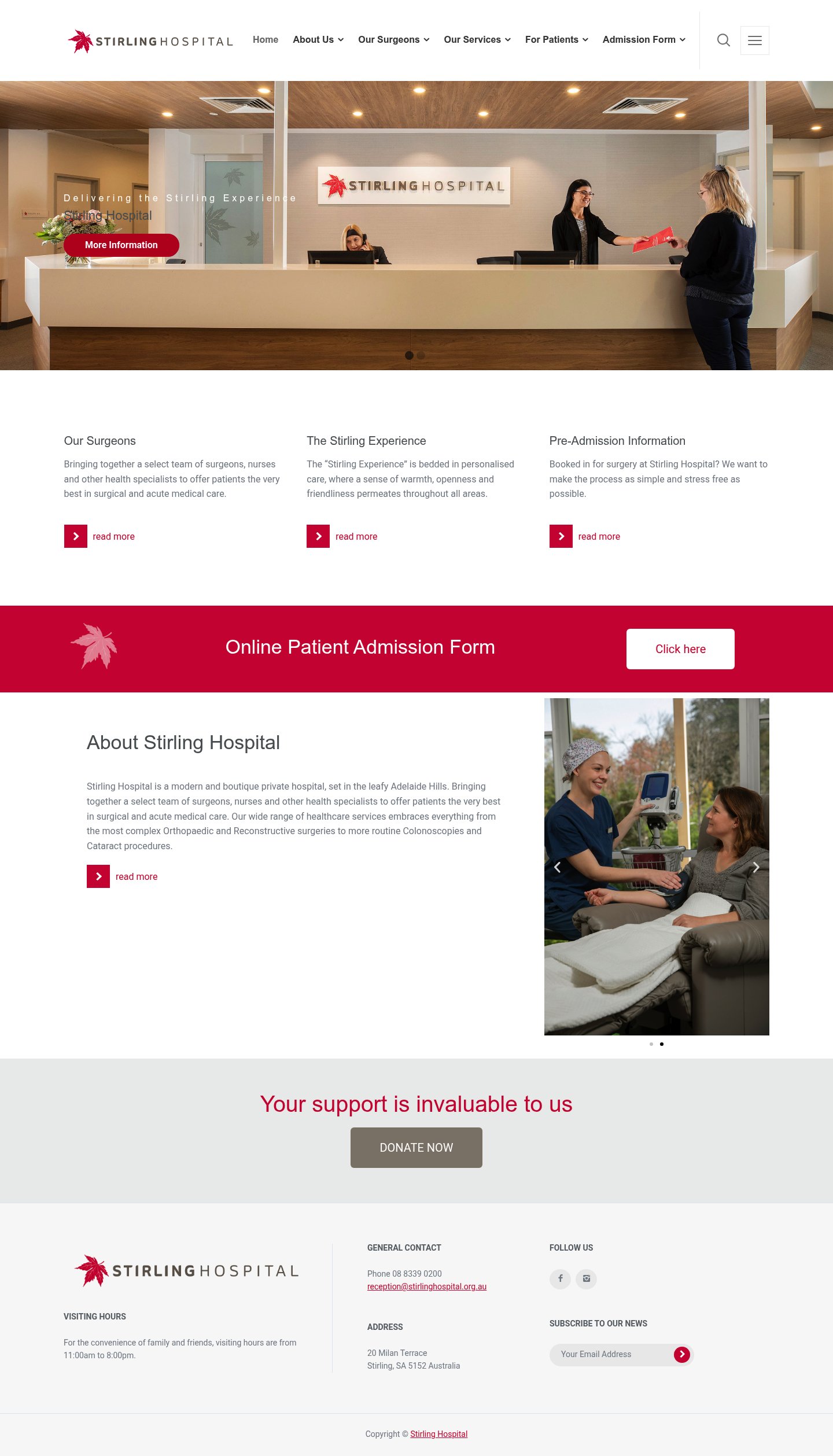
Stirling Hospital in the Adelaide Hills (Stirling) has built clear clinical depth and a boutique private-hospital reputation across South Australia, offering multi-speciality surgical and acute medical care to private patients and GP referrers. The website lists surgeons, accreditation and board members, but those credibility elements are visually deprioritised and homepage imagery reads more like a small outpatient clinic than a multi-speciality surgical hospital. That mismatch is letting GPs and higher-value patients shortlist elsewhere, costing elective admissions and a predictable referral flow.
Stirling Hospital's online presence — what the data reveals
AI Visibility
Moderate
Authority Score
22
out of 100
Organic traffic
2478
est. monthly visits
Traffic Trend
+17
%
past 12 months
Organic Keywords
456
ranking terms
Keyword Trend
+49
%
past 12 months
Backlinks
316
total
Paid traffic
0
0 paid campaigns
Digital maturity
Level 1
out of 5
How your website scores
UX OBSERVATIONS
Under-signalling clinical credibility creates friction for GP referrals because surgeon credentials, outcomes and accreditation badges are not visible or emphasised in the top fold.
Hero messaging and CTA hierarchy dilute conversion intent; the primary CTA is visually weak and the headline copy does not prioritise booking or referral actions.
Visual tone skews consumer-boutique rather than clinically authoritative; that mismatch will limit conversion of risk‑averse patients and professional referrers despite a competent visual execution.
TECH STACK
Two more things we noticed
- Clinical proof is hidden where decisions are made. Accreditation, board, surgeon profiles and outcomes exist in the architecture but are low-contrast and not fronted on pages where referral and admission decisions are taken, costing enquiries and direct bookings.
- Conversion paths are fragmented and low-value. CTAs are low contrast and equal-weight service tiles fragment attention, while technical services (orthopaedics, neurosurgery, paediatrics) need prioritised pathways and clearer contact/booking flows to convert high-trust referrals.

Ready to find out what stronger digital growth could look like
Book a free 20-minute call. We’ll map the gap between your commercial goals and digital capability, then design the system to close it.
This report was prepared by Redfox Digital using publicly available SEO, UX and reputation data.