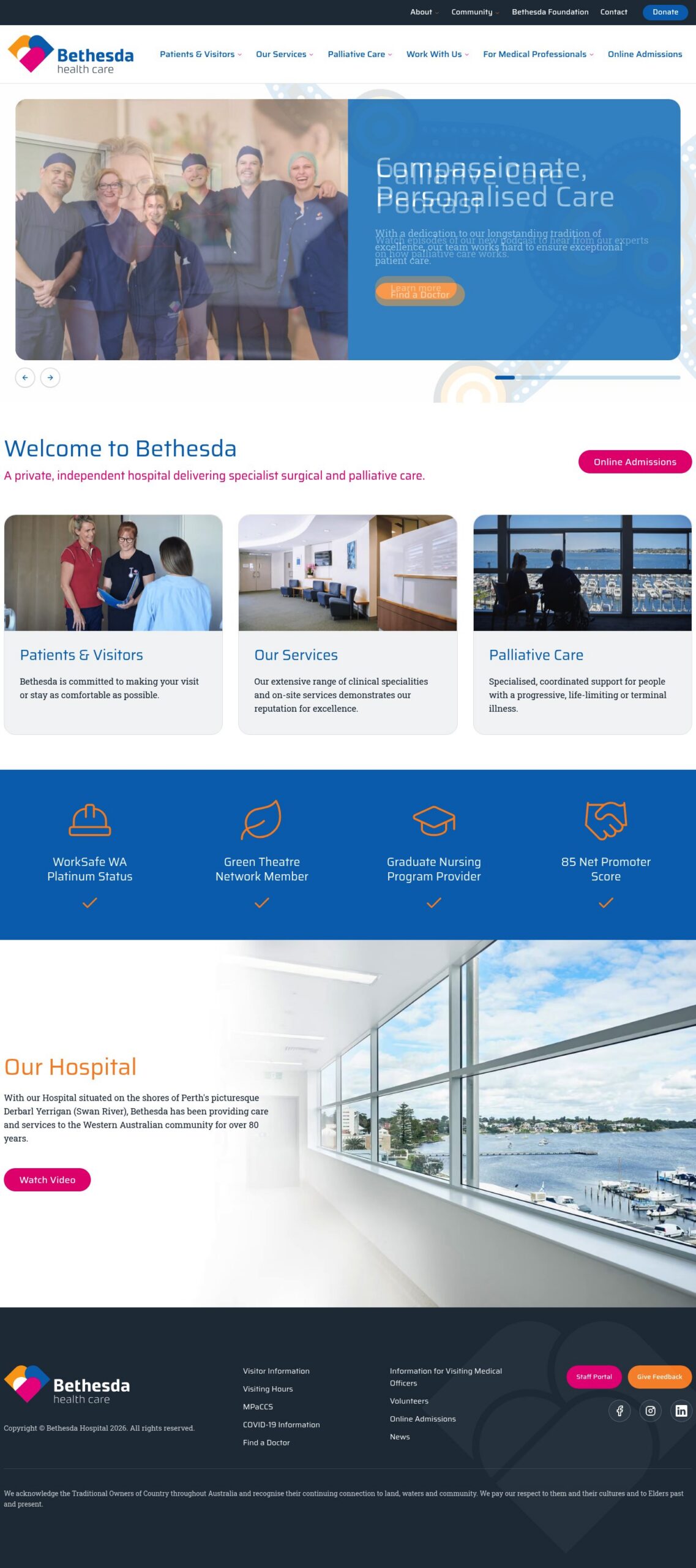
Bethesda Health Care has built decades of clinical achievement in Perth, national awards, WorkSafe Platinum recognition and measurable MPaCCS outcomes, plus a strong public rating of 4.5 from 111 Google reviews. That institutional credibility is not translating into the referrals, inpatient admissions or philanthropic enquiries you rely on because the homepage and hero present like a single-clinic site. As a result, clinicians, potential inpatients and donors arrive with the wrong impression and drop out before they make a decision.
Your online reputation
4.5
Google star rating
111
Verified reviews
High
Reputation strength
Google Business Profile
Your online presence — what the data reveals
AI Visibility
Low
Authority Score
30
out of 100
Organic traffic
5303
est. monthly visits
Traffic Trend
-26
%
past 12 months
Organic Keywords
277
ranking terms
Keyword Trend
-78
%
past 12 months
Backlinks
1073
total
Paid traffic
0
0 paid campaigns
Digital maturity
Level 2
out of 5
Bethesda’s hardest to copy assets are its eighty-plus years of continuous service in Western Australia and a strong public reputation, shown by a 4.5 Google rating from 111 reviews. Combined with WorkSafe Platinum and national awards plus demonstrable MPaCCS outcomes, these assets make it possible to significantly increase specialist referrals, inpatient admissions and donor enquiries if the digital presence finally reflects that leadership.
How your website scores
TECH STACK
UX OBSERVATIONS
Hero messaging is legible but visually deprioritised by overlays and decorative graphics, reducing perceived clinical competence and weakening immediate trust for time-pressed referrers.
Navigation and content blocks give equal weight to all audiences, failing to guide referrers, prospective patients or donors to a single clear next step and thereby diluting conversion for high-value actions.
Trust signals and institutional credentials are present but visually small and de-emphasised, under-signalling decades of credibility and reducing appeal to clinicians and philanthropists who require clear authority cues.
Organic visibility has weakened: monthly traffic has fallen from about 7,183 a year ago to roughly 5,351 now, and ranking keywords have dropped from 1,194 to 268. That decline means fewer clinicians, patients and donors are finding Bethesda at the moment they make decisions, so your strong reputation is not driving the referrals or philanthropic leads it could.
The three gaps holding you back
What's possible when these gaps are closed
Lead with the upside: emphasise your 80+ years, WorkSafe Platinum award and national recognition so clinicians and donors immediately see Bethesda as a hospital organisation, not a small clinic. Rewriting the homepage hero and primary messaging to state that history and outcomes will cut the time it takes decision makers to trust Bethesda and increase the number of specialist referrals and philanthropic enquiries.
Lead with the upside: surface award badges, MPaCCS outcome summaries and the 4.5 rating from 111 Google reviews on pages where clinicians, patients and donors decide. Structuring these proof points into consistent blocks on service, about and referral pages will amplify credibility and shorten the path from discovery to referral or donation.
Lead with the upside: build distinct CTAs and flows for inpatient admissions, specialist referrals and philanthropic enquiries rather than privileging simple bookings. With roughly 5,351 monthly organic visitors, directing even a small percentage into tailored admission and donor enquiry paths will grow admissions and donor leads far more than optimising low-value booking clicks.
This report was prepared by Redfox Digital using publicly available SEO, UX and reputation data.