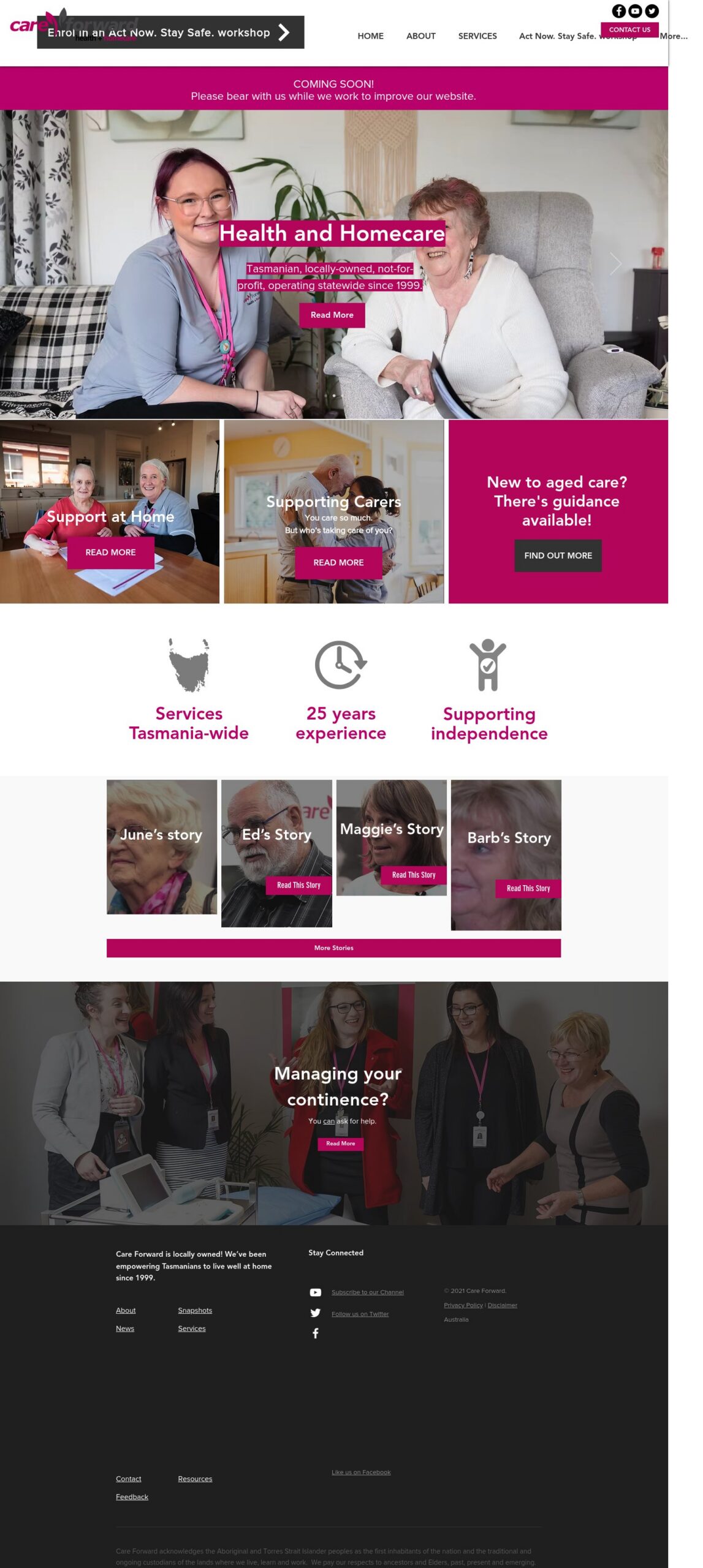
Careforward has built longstanding local credibility and a statewide clinical footprint delivering in-home health, allied health and reablement across Tasmania. That real-world reputation and governance content are visible in places, but the site reads like a private clinic and mutes the signals families and referrers need. That mismatch is costing missed inbound referrals and family leads who instead choose clearer public or government providers.
Your online reputation
2.3
Google star rating
3
Verified reviews
Medium
Reputation strength
Google Business Profile
Your online presence — what the data reveals
AI Visibility
Low
Authority Score
19
out of 100
Organic traffic
342
est. monthly visits
Traffic Trend
-4
%
past 12 months
Organic Keywords
151
ranking terms
Keyword Trend
+33
%
past 12 months
Backlinks
241
total
Paid traffic
0
0 paid campaigns
Digital maturity
Level 1
out of 5
Careforward’s 26 years of continuous service across Tasmania and its statewide clinical scope are assets competitors would struggle to replicate. You also publish three recent annual reports and a set of local case stories that demonstrate governance and outcomes. If the digital presence catches up, these assets make it possible to convert many more inbound referrals and family enquiries directly online.
How your website scores
TECH STACK
UX OBSERVATIONS
A prominent "COMING SOON" site banner publicly signals work-in-progress and reduces perceived operational reliability, lowering referral and family enquiry conversion rates.
Multiple equal-weight CTAs and tiles without a single primary action dilute decision-making and fail to drive urgent enquiries or referrals to a clear contact route.
Governance and long tenure are present in navigation but not surfaced visually as authoritative cues, so the homepage under-signals organisational credibility and weakens trust for risk-averse audiences.
A national search rank around 340,014 and just 342 organic visits a month mean most Tasmanian families and clinicians are not finding Careforward when they look. A Google rating of 2.3 from three reviews and an authority score of 19 mean that when people do arrive they do not get the online reassurance that matches 26 years of service, so referral enquiries are being lost.
The three gaps holding you back
What's possible when these gaps are closed
Showcase the 26 years of local service and lead with a short priorities list in the hero so families and referrers see relevance within seconds. That simple change can keep a bigger share of the 342 monthly organic visitors on site long enough to read services and make a referral or enquiry.
Place clear proof points from the three published annual reports, board governance and local case stories directly on service pages so clinicians and families can confirm legitimacy at decision time. Making those signals obvious should lift perceived authority from the current score of 19 and turn more passive visits into direct referral contacts.
Replace one-size-fits-all booking prompts with simple triage steps and referrer-focused evidence so complex offers like allied health and package coordination are easier to act on. With keywords up by 33 year on year, clearer pathways will help convert that rising search interest into enquiries instead of losing people to other providers.
This report was prepared by Redfox Digital using publicly available SEO, UX and reputation data.