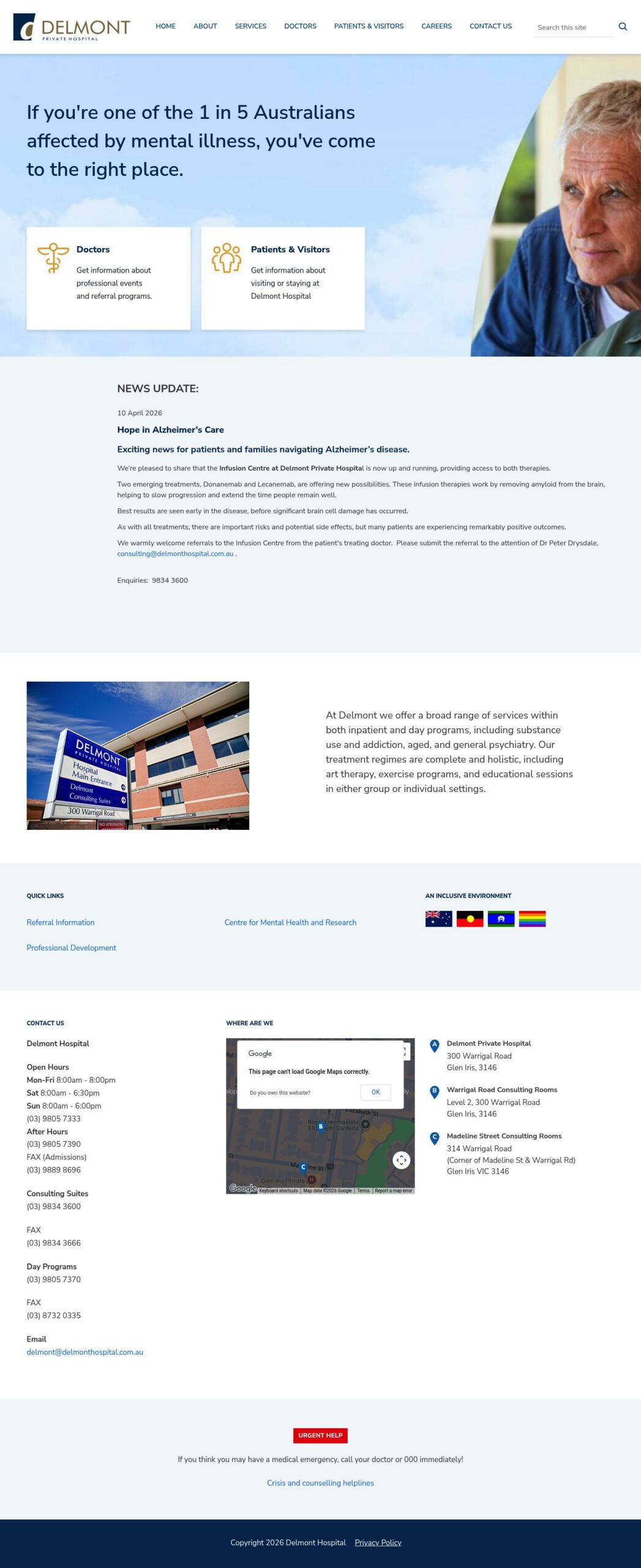
Delmont has built recognised specialist inpatient and day programs in Glen Iris that serve clinicians, families and patients across metropolitan Melbourne. The site, however, visually signals musculoskeletal care and prioritises consumer booking flows over clinician referral steps and clear outcome evidence, so many clinicians and high-value referrers leave without assessing accreditation or specialist programs. With a 2.5 Google rating across 104 reviews and steady organic traffic of about 8,183 visits a month, correcting that mismatch at the top of the site would unlock referrals that already look for Delmont online.
Your online reputation
2.5
Google star rating
104
Verified reviews
Medium
Reputation strength
Google Business Profile
Your online presence — what the data reveals
AI Visibility
Moderate
Authority Score
27
out of 100
Organic traffic
8183
est. monthly visits
Traffic Trend
-17
%
past 12 months
Organic Keywords
838
ranking terms
Keyword Trend
-22
%
past 12 months
Backlinks
394
total
Paid traffic
0
0 paid campaigns
Digital maturity
Level 2
out of 5
Delmont’s hardest to replicate assets are its accredited specialist clinical services across aged mental health, substance use, youth services and TMS, together with an established regional reach of about 8,183 organic visitors per month. Those strengths are supported by 155 referring domains and 394 backlinks that already point to the hospital. If the site led with accreditation and clinician-facing evidence, those real-world capabilities and existing online reach could convert into a reliable stream of higher-value clinician referrals.
How your website scores
TECH STACK
UX OBSERVATIONS
Trust signals exist (contact, address, news) but are not carrying enough visual authority or clinical specificity to match a specialist hospital, diluting professional confidence.
Primary conversion paths are unclear - the Doctors card is low-contrast and secondary, so referrers cannot quickly find referral steps or clinician credentials, weakening referral conversion.
The visual system is clean but generic and non-hierarchical, which fails to communicate clinical scale or specialisation and therefore under-signals premium clinical capability to both referrers and patients.
Because the homepage reads like a different speciality, a large share of the 8,183 monthly visitors and clinicians coming from 155 referring domains leave before they see clinical outcomes. That effect, amplified by a 2.5 Google rating across 104 reviews, means enquiries are less likely to convert into the high-value referrals that fund longer inpatient stays and specialist programs.
The three gaps holding you back
What's possible when these gaps are closed
Showcasing psychiatric specialty at the top will keep clinicians and referrers on the page and let them assess accreditation and outcomes. Even a 1 percent lift from the current 8,183 monthly visitors would be about 82 more qualified sessions to convert into referrals.
Improving the Google rating from 2.5 by actively managing the 104 reviews will change first impressions for families and referrers. A clearer average rating would increase click-through and enquiry quality, making existing traffic worth more.
Prioritising clinician workflows and admission coordination in navigation can turn passive referrals into direct clinician contacts and faster admissions. Directing some of the 155 referring domains and inbound enquiries to a simple referral landing page with outcome evidence could lift high-value conversions enough to pay for the work.
This report was prepared by Redfox Digital using publicly available SEO, UX and reputation data.