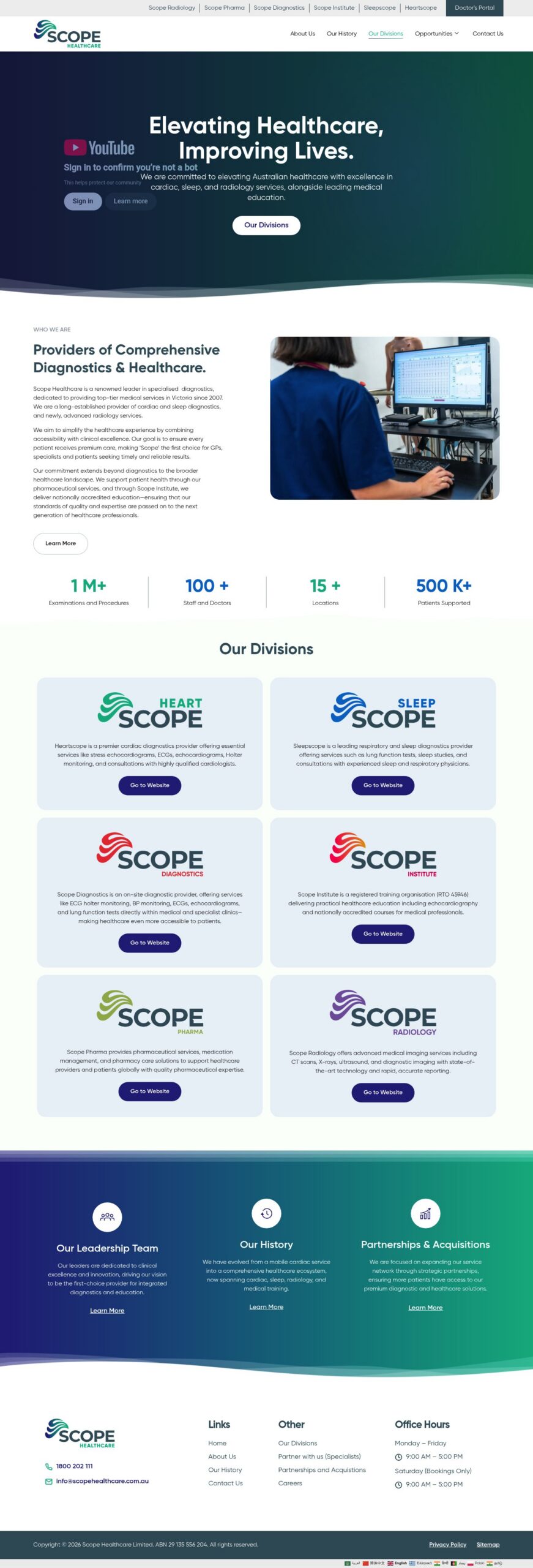
Heartscope Limited in Clifton Springs has built broad clinical capability across cardiac, sleep and respiratory, radiology, pharmaceutical services and accredited training for GPs and patients. That scale and local reputation are visible in public signals and search presence, yet the site’s visual messaging, clinical proof and service clarity are not matching what professional referrers expect. As a result, GPs and hospitals who could refer complex diagnostics are less likely to shortlist Heartscope and institutional enquiries are underdeveloped.
Your online reputation
3.3
Google star rating
116
Verified reviews
Medium
Reputation strength
Google Business Profile
Your online presence — what the data reveals
AI Visibility
Low
Authority Score
9
out of 100
Organic traffic
837
est. monthly visits
Traffic Trend
+262
%
past 12 months
Organic Keywords
287
ranking terms
Keyword Trend
+202
%
past 12 months
Backlinks
81
total
Paid traffic
0
0 paid campaigns
Digital maturity
Level 2
out of 5
Heartscope’s hardest-to-copy assets are its genuine multi-division clinical footprint across cardiac, sleep and radiology plus accredited training programmes for GPs and patients, and a measurable local footprint with 116 public Google reviews. Organic reach is already trending up, growing from 231 to 837 visits per month over the last year and keyword coverage rising from 95 to 287. If the public presentation and service clarity catch up, those assets can be turned into steady referral leads and reliable institutional enquiries.
How your website scores
TECH STACK
UX OBSERVATIONS
A distracting YouTube sign-in overlay in the hero weakens first impression and actively reduces perceived professionalism, increasing friction for decision makers evaluating clinical competence.
Primary CTA drives to 'Our Divisions' rather than to referral or booking actions, which fragments the user journey and fails to channel GPs or patients toward the most commercially valuable steps.
Trust cues exist but lack hierarchy and specificity - generic metrics and division logos do not substitute for clinician credentials, accreditation badges, turnaround promises or clear proof points, so confidence for clinical referral remains under-signalled.
Having 116 Google reviews alongside a 3.3 average rating makes many GPs and hospitals pause when comparing providers, reducing shortlist inclusion for complex diagnostics. Modest organic traction — 837 visits per month, an authority score of 9 and just 30 referring domains — means specialist discovery and predictable institutional enquiries remain limited. Without clearer clinical proof and professional-focused messaging, the business will under‑monetise the clinical capacity it already has.
The three gaps holding you back
What's possible when these gaps are closed
Turn the 116 existing Google reviews and visible accreditations into clear clinical evidence for referrers by publishing outcome metrics, clinician credentials and a dedicated referral pathway on the pages GPs and hospitals check. A concise audit summary and clinician profiles that cite procedure volumes and accreditation numbers will make shortlisting simpler and increase institutional enquiries.
Project a clearly clinical identity by replacing consumer physiotherapy-style hero imagery with specialist photography, clinician credentials and a straightforward referral CTA aimed at GPs. That change will help convert a higher share of the current 837 monthly visitors who are evaluating your services into referral enquiries and professional contacts.
Build on the jump from 231 to 837 monthly visits and the climb from 95 to 287 ranked keywords by creating targeted content for GP and hospital search terms and by earning links from specialist organisations to lift authority above the current score of 9. That will move Heartscope from sporadic discovery to a steadier pipeline of institutional enquiries aligned with your clinical capacity.
This report was prepared by Redfox Digital using publicly available SEO, UX and reputation data.