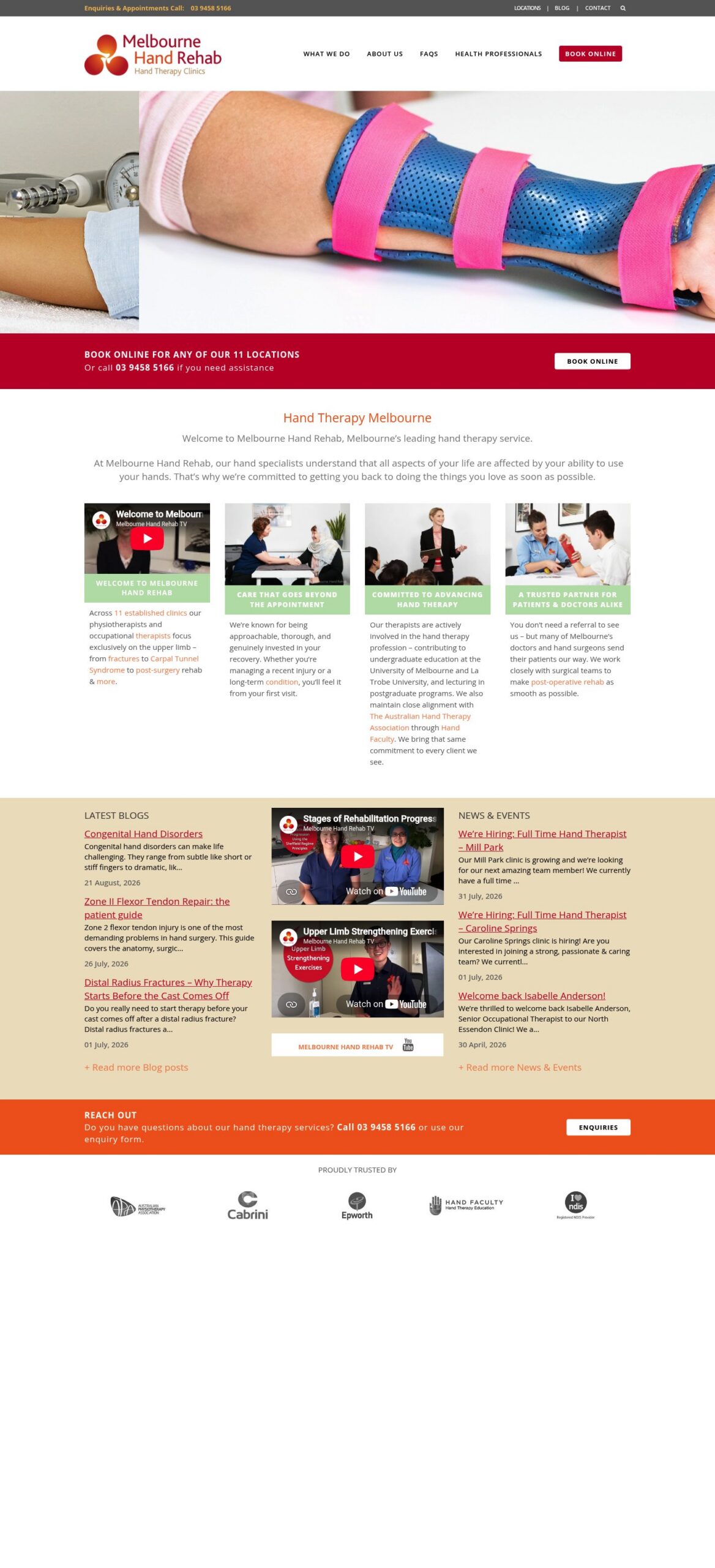
Melbourne Hand Rehab has built real credibility through a specialist hand therapy network offering in-clinic, telehealth and home-visit care across multiple Melbourne suburbs and a 4.6 Google rating from 30 reviews. That clinical reputation and multi-site scale are not converting into more booked patients because the website does not present specialised hand expertise or guide condition-specific booking paths. As a result, patients searching for wrist, post-operative or musician-related hand care and referral partners are dropping off or going to competitors instead.
Your online reputation
4.6
Google star rating
30
Verified reviews
High
Reputation strength
Google Business Profile
Your online presence — what the data reveals
AI Visibility
Moderate
Authority Score
22
out of 100
Organic traffic
4445
est. monthly visits
Traffic Trend
-3
%
past 12 months
Organic Keywords
1501
ranking terms
Keyword Trend
-73
%
past 12 months
Backlinks
865
total
Paid traffic
0
0 paid campaigns
Digital maturity
Level 2
out of 5
Your strongest assets are a clear local reputation, shown by a 4.6 Google rating from 30 reviews, and a real multi-location specialist footprint across Melbourne suburbs that includes in-clinic, telehealth and home visits. You also attract roughly 4,445 organic visitors each month, which shows there is demand to convert. Those assets make it possible to drive materially more booked patients if the site signals your specialised hand expertise at the booking moment.
How your website scores
TECH STACK
UX OBSERVATIONS
Specialisation is stated but not proven in-place; consequence: prospective patients and health professional referrers cannot quickly verify clinical credentials or program outcomes, lowering referral conversion and high-value bookings.
Booking path is visible but not prioritised or contextualised; consequence: visitors must decide service and location without guided choices, increasing friction and abandoned booking attempts.
Trust cues are present but visually weak and low on detail; consequence: partner logos and small therapist images do little to reduce perceived clinical risk, limiting uptake from risk-averse patients and professional referrers.
Despite a strong 4.6 rating and established local demand, a 73% drop in ranked keywords and a flat traffic trend mean you are losing visibility for the condition-specific searches that produce bookings. Left unaddressed, that gap turns ready-to-book local patients and referral opportunities into missed appointments or calls to competitors because the site does not surface your specialist expertise where patients decide.
The three gaps holding you back
What's possible when these gaps are closed
Convert your 4.6 Google rating and 30 public reviews into clearer, targeted signals on the homepage and condition pages so visitors trust you at the booking moment. Even modest improvements could lift booking rates from the roughly 4,445 monthly visitors you already receive and capture more local demand.
Restructure services into symptom or outcome paths so someone with carpal tunnel, a wrist fracture or post-op needs can find a tailored booking path in seconds. With 1,501 keywords still ranking and offerings like telehealth and home visits, organising pages by patient intent will reduce friction and increase completed bookings.
Place prominent 4.6 rating badges and targeted testimonials on condition and booking pages to reassure patients at the decision point. Combined with your clinic network and external recognition shown by 865 backlinks from 216 referring domains, this makes your social proof harder for competitors to match and easier to turn into booked consultations.
This report was prepared by Redfox Digital using publicly available SEO, UX and reputation data.