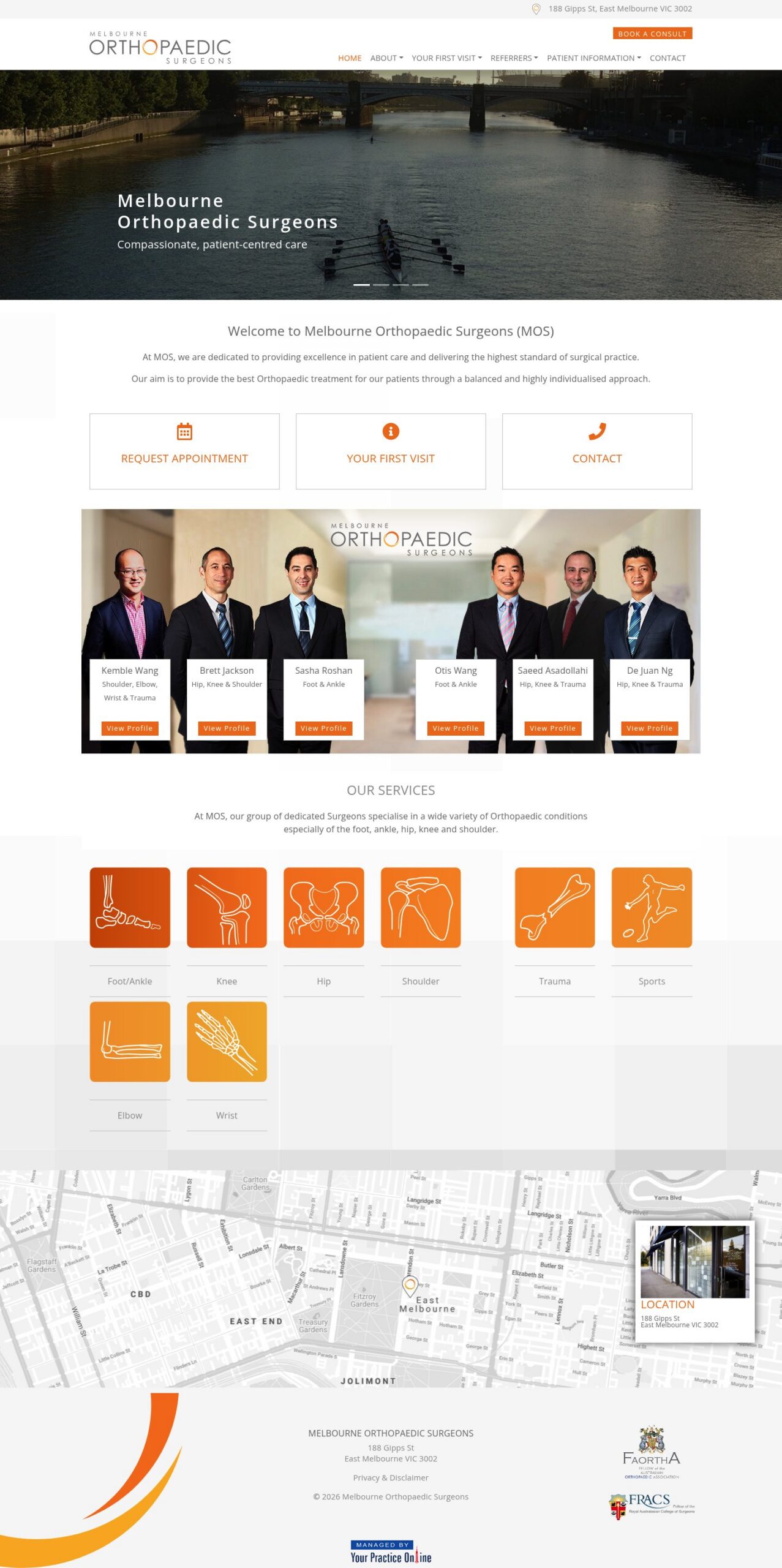
We reviewed Melbourne Orthopaedic Surgeons at 188 Gipps St, East Melbourne and found a group of Australian trained surgeons with real clinical credibility and growing search traction. That credibility and long standing referral relationships are not turning into booked high value consults because the homepage visuals and booking pathways read more like a consumer physiotherapy brand than a specialist surgical practice. As a result, higher acuity patients and referring GPs are likely dropping out before they book because surgeon credentials and referral cues are not made prominent.
Your online reputation
5
Google star rating
3
Verified reviews
Medium
Reputation strength
Google Business Profile
Your online presence — what the data reveals
AI Visibility
Low
Authority Score
19
out of 100
Organic traffic
1697
est. monthly visits
Traffic Trend
+21
%
past 12 months
Organic Keywords
458
ranking terms
Keyword Trend
-15
%
past 12 months
Backlinks
7009
total
Paid traffic
0
0 paid campaigns
Digital maturity
Level 2
out of 5
Your team of Australian trained orthopaedic surgeons and public appointments are a genuine, hard to replicate asset, and your 5.0 Google rating confirms strong patient experience despite only three reviews. You also have a substantial offsite footprint with 7,009 backlinks from 1,696 referring domains. If the website’s visual language and booking flows are brought into line with that clinical authority, those assets can be turned into more booked specialist consults and a stronger referral pipeline.
How your website scores
TECH STACK
UX OBSERVATIONS
Trust signals are present but not carrying enough visual authority; surgeon photos and professional badges are small and visually de-prioritised, so referrers and risk-averse patients will not attain quick confidence and will defer to competitors with stronger credential display.
Primary conversion pathway is fragmented and under-signalled; the top 'Book a Consult' CTA is visually weak and on-page appointment controls are low contrast, which increases page friction and reduces predictable consult bookings.
Hierarchy fails to structure clinical decision-making; services and surgeon specialisms are listed without guiding a user to the correct clinician or urgency level, so complex cases and busy GPs will not find a fast triage route and will be less likely to refer.
With roughly 1,700 organic visits each month but an authority score of 19, the site is pulling in demand without the domain weight or on‑site signals buyers expect for specialist surgery. That gap means many GPs and higher acuity patients arrive curious but do not progress to high value consults. Traffic is increasing year on year, so the opportunity to capture those visits is real, but only if decision paths and booking cues improve quickly.
The three gaps holding you back
What's possible when these gaps are closed
Lead with surgeon credentials and institutional cues so referring GPs and complex patients recognise specialist authority at a glance. By foregrounding Australian training, public appointments and clear surgeon roles, you can convert a higher share of the existing ~1,700 monthly organic visitors into paid consults and make referrals more likely to choose your group.
Make the primary call to action visually dominant and simplify the booking flow so it is easier to complete from any device. Given current demand and available surgeon capacity, reducing friction around the booking pathway will cut avoidable lost bookings and turn routine site visits into confirmed appointments.
Replace service sprawl with clear referral‑facing pathways, short outcome summaries and concise decision aids that show who treats what and what results to expect. Your site already ranks for about 470 keywords; tighter, referral-focused content will make those rankings work harder and shorten the time from referral to booked consult.
This report was prepared by Redfox Digital using publicly available SEO, UX and reputation data.