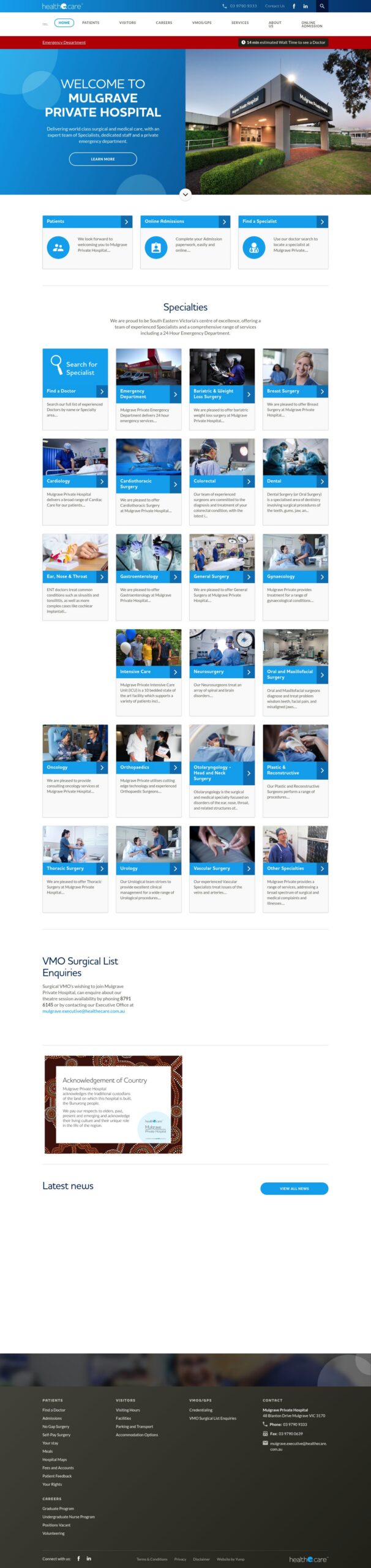
Mulgrave Private Hospital has built real scale and local credibility: 35+ years of service, a 24-hour emergency department and multiple surgical specialties serving south eastern Melbourne, regional Victoria and some Tasmanian patients. You also have 549 Google reviews at a 4.0 rating, yet that reputation and clinical breadth are not translating into online referrals or elective admissions. The homepage and specialist and admissions pages present with low visual weight, steering enquiries offline and losing self-pay patients who expect clearer online pathways.
Your online reputation
4
Google star rating
549
Verified reviews
High
Reputation strength
Google Business Profile
Your online presence — what the data reveals
AI Visibility
Moderate
Authority Score
32
out of 100
Organic traffic
9767
est. monthly visits
Traffic Trend
-31
%
past 12 months
Organic Keywords
1501
ranking terms
Keyword Trend
-49
%
past 12 months
Backlinks
1257
total
Paid traffic
0
0 paid campaigns
Digital maturity
Level 1
out of 5
You have two assets competitors will struggle to match: long standing local clinical scale with a 24-hour emergency service and multiple surgical specialties, and a large body of local endorsement with 549 Google reviews at a 4.0 rating. If your online presence is brought into alignment with that reputation, those assets can drive more online referrals and predictable elective admissions.
How your website scores
TECH STACK
UX OBSERVATIONS
The 'world class' positioning is unsupported by visible clinical proof (accreditations, outcomes, consultant credentials); this creates hesitation for referrers and self-funding patients and reduces conversion intent.
Visual hierarchy fails to prioritise urgent decision paths (find a specialist, refer, book admission, emergency); important actions compete with generic navigation and a weak hero CTA, causing lost referral and admission flow.
Trust signals are present but not carrying enough visual authority; the grid of specialties looks like an index rather than evidence of depth, diluting perceived clinical leadership and lowering likelihood of immediate contact or booking.
Month to month visibility is slipping: organic traffic is about 9,767 visits and has fallen roughly 31% year on year, while ranked keywords are down about 49% to around 1,500 terms. That drop in findability means fewer GPs and self-pay patients are landing on the specialist and admissions pages that convert, so more enquiries go to the phone and into ad hoc referral paths. Put simply, you have enough reputation and demand to increase elective admissions, but the current site structure is losing that opportunity.
The three gaps holding you back
What's possible when these gaps are closed
Lead with the upside by making the 24-hour emergency department, surgical specialties and 35+ years of service obvious in the hero and primary messaging. With roughly 9,767 organic visits a month, a clearer presentation of scale will make referrers and self-pay patients far more likely to engage online rather than default to a phone call.
Make Admissions, Online Admission Forms and Find a Doctor prominent in the primary navigation and increase their visual weight so decision paths are immediate and friction free. Since those forms and pages already exist, better placement can convert a larger share of the current monthly traffic into predictable elective bookings and reduce unnecessary phone traffic.
Place the 549 Google reviews, the 4.0 rating and your decades of service alongside specialist profiles and admissions pages so that social proof influences decisions at the moment they matter. That targeted use of reputation will help turn local goodwill into more online referrals and self-pay admissions.
This report was prepared by Redfox Digital using publicly available SEO, UX and reputation data.