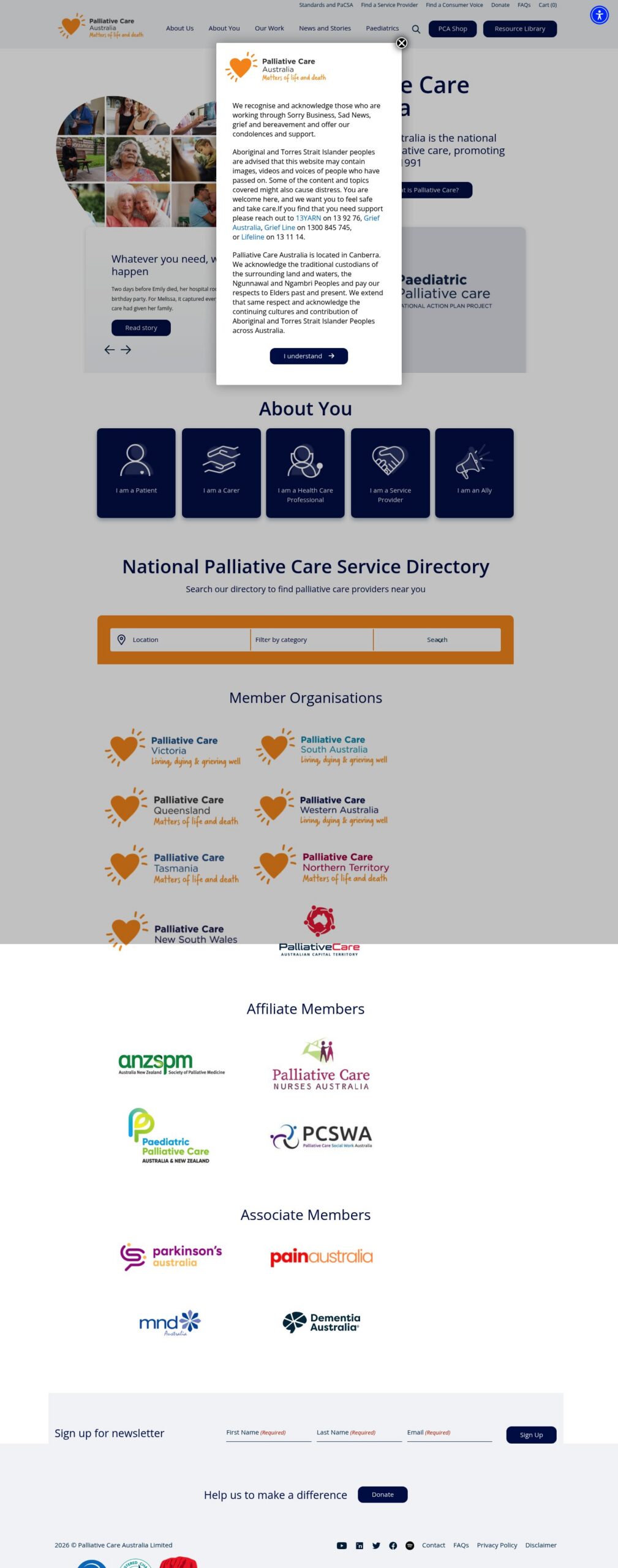
Palliative Care Australia has built national standing since 1991 and represents patients, carers, clinicians, service providers and policymakers across the country. That institutional credibility is backed by a strong backlink profile of about 28,100 backlinks from roughly 1,975 referring domains and an authority score of 38, yet the site reads like a transactional clinic and fragments audiences. As a result, donors, funders and policy partners who should be engaging with the organisation are slipping away before they see the national role and impact.
Your online reputation
Google star rating
Verified reviews
High
Reputation strength
Google Business Profile
Your online presence — what the data reveals
AI Visibility
Moderate
Authority Score
38
out of 100
Organic traffic
14561
est. monthly visits
Traffic Trend
+40
%
past 12 months
Organic Keywords
2663
ranking terms
Keyword Trend
-43
%
past 12 months
Backlinks
28100
total
Paid traffic
0
0 paid campaigns
Digital maturity
Level 2
out of 5
Palliative Care Australia is the national peak body since 1991 with an established role across patients, carers, clinicians and policymakers. That reputation is underpinned by around 28,100 backlinks from roughly 1,975 referring domains and about 14,500 monthly organic visits. If the digital presence is aligned to that reputation, those hard to replicate assets could drive materially more funder, partner and referral outcomes.
How your website scores
TECH STACK
UX OBSERVATIONS
A full-screen acknowledgement modal blocks the hero and primary CTA, fragmenting the first impression and reducing the chance that high-value visitors engage with leadership messaging.
The page foregrounds a service directory and member logos, which frames the organisation as a local referral engine rather than a national policy leader, under-signalling strategic authority to funders and partners.
Multiple equal-weight CTAs (tiles, directory search, shop, donate, newsletter) fail to structure decision-making; this dilutes conversion intent and increases drop-off for visitors with clear, high-priority goals.
With roughly 14,000 monthly visitors but a homepage and navigation that read as a transactional clinic, most of that attention is not converting into donor, funder or referral outcomes. Despite 28,100 backlinks and nearly 2,000 referring domains, decision makers are not seeing the institutional cues they need, so high-value partnerships and shortlists are being missed. The mismatch between reach and message means reach is under‑leveraged where it matters most.
The three gaps holding you back
What's possible when these gaps are closed
Make the organisation’s institutional credibility the primary story and you turn authority into opportunities. With 28,100 backlinks and about 1,975 referring domains, surfacing that proof in the places funders look could win more shortlists and multi-year grants rather than one-off enquiries.
Reframe the homepage hero and primary calls to action to show national remit and impact, not bookings. With roughly 14,000 monthly visitors, a clearer hero and audience pathways would channel that traffic into donations, strategic partnership conversations and policy engagement instead of transactional clicks.
Separate patient, carer, clinician and funder journeys so each audience finds the tailored proof and next step they need. If focused pathways convert just 2 percent more of the 14,561 monthly visitors, that is about 290 additional engaged contacts a month for funder, partner and referral pipelines.
This report was prepared by Redfox Digital using publicly available SEO, UX and reputation data.