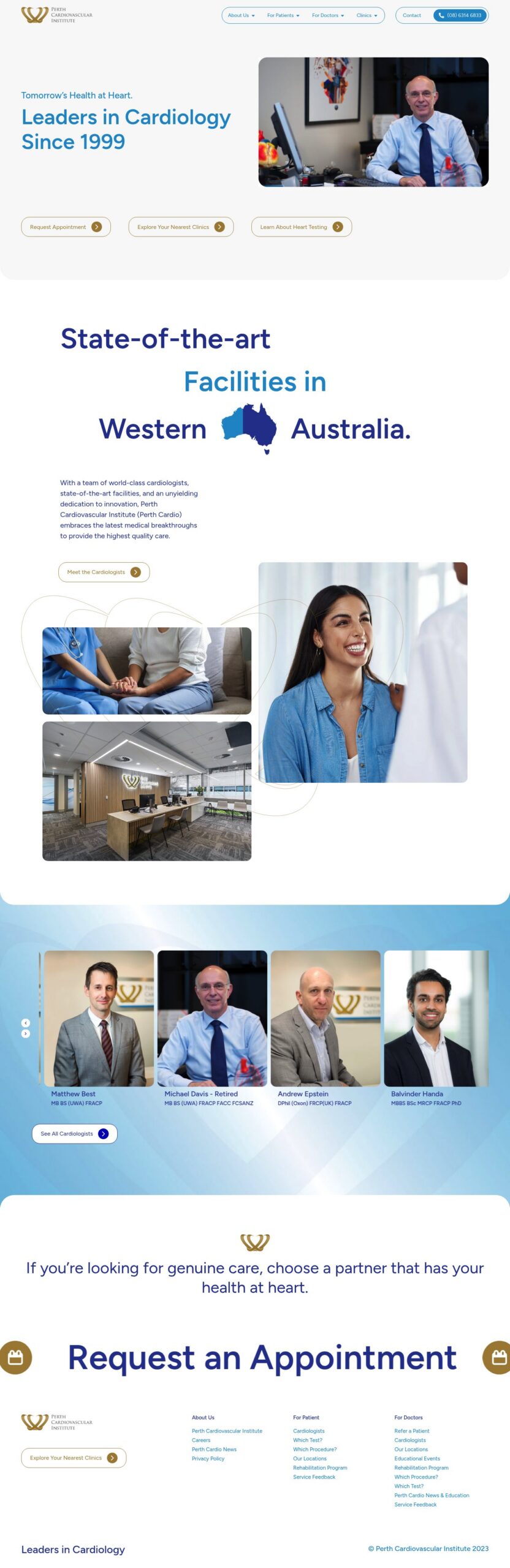
Perth Cardiovascular Institute has built a recognised multi-location specialist cardiology practice serving metro and regional Western Australia. Named cardiologists and clear clinical scale appear in site content, yet the homepage hero and referral pathways do not surface those credentials or prioritise booking actions. That mismatch means GPs and patients who need fast verification are dropping out before they make a referral or booking.
Your online reputation
3
Google star rating
2
Verified reviews
Medium
Reputation strength
Google Business Profile
Your online presence — what the data reveals
AI Visibility
Moderate
Authority Score
21
out of 100
Organic traffic
2313
est. monthly visits
Traffic Trend
+1
%
past 12 months
Organic Keywords
691
ranking terms
Keyword Trend
+74
%
past 12 months
Backlinks
634
total
Paid traffic
0
0 paid campaigns
Digital maturity
Level 2
out of 5
You have clinical scale and named specialists across metro and regional Western Australia, and a growing organic footprint of about 2,317 monthly visits and 691 organic keywords. You also have an established backlink profile with 188 referring domains and 634 backlinks, a base of external validation that competitors will find hard to replicate quickly. If the digital presence catches up to these assets, they can be turned into noticeably more GP referrals and patient bookings.
How your website scores
TECH STACK
UX OBSERVATIONS
Clinical credibility is shown (cardiologist portraits, facility imagery) but not carrying enough visual authority to drive referrals or bookings; credentials and proof points are low-contrast and secondary, diluting trust when a quick decision is required.
Primary conversion intent is fractured: multiple low-contrast CTAs in the hero and a large 'Request an Appointment' buried lower create decision friction and reduce the likelihood of immediate action from both patients and referrers.
Navigation and page hierarchy fail to separate and serve two distinct audiences (patients and referring clinicians); this lack of clear pathways is creating commercial friction by forcing users to hunt for referral/booking steps rather than converting on the homepage.
Despite roughly 2,317 monthly organic visits and 691 ranked keywords, that traffic is not reliably converting into referrals because clinician proof and referral cues are not visible at the moment of decision. A Google rating of 3.0 from 2 reviews and an authority score of 21 make first impressions fragile for busy GPs who need quick confirmation of competence.
The three gaps holding you back
What's possible when these gaps are closed
Putting named cardiologists and senior clinician credentials in the top fold makes expertise obvious the moment a GP or patient lands on the page, turning more of the current 2,317 monthly visitors into verified referral opportunities. A clear top-fold credential cluster paired with a single prominent booking or refer button will cut friction for time-poor referrers.
Surface referral pathways, subspecialty labels and clinician proof on key decision pages so GPs can verify competence without hunting through the site. With 691 organic keywords already driving discovery, surfacing that proof will convert a higher share of existing traffic into direct referrals and bookings.
Optimise the Google Business Profile, showcase patient and referrer evidence on decision pages, and make outcomes visible so a 3.0 rating from 2 reviews does not set the first impression. Given 188 referring domains and a growing keyword set, better review management and clear referral evidence can lift trust and increase booked consultations from both metro and regional referrers.
This report was prepared by Redfox Digital using publicly available SEO, UX and reputation data.