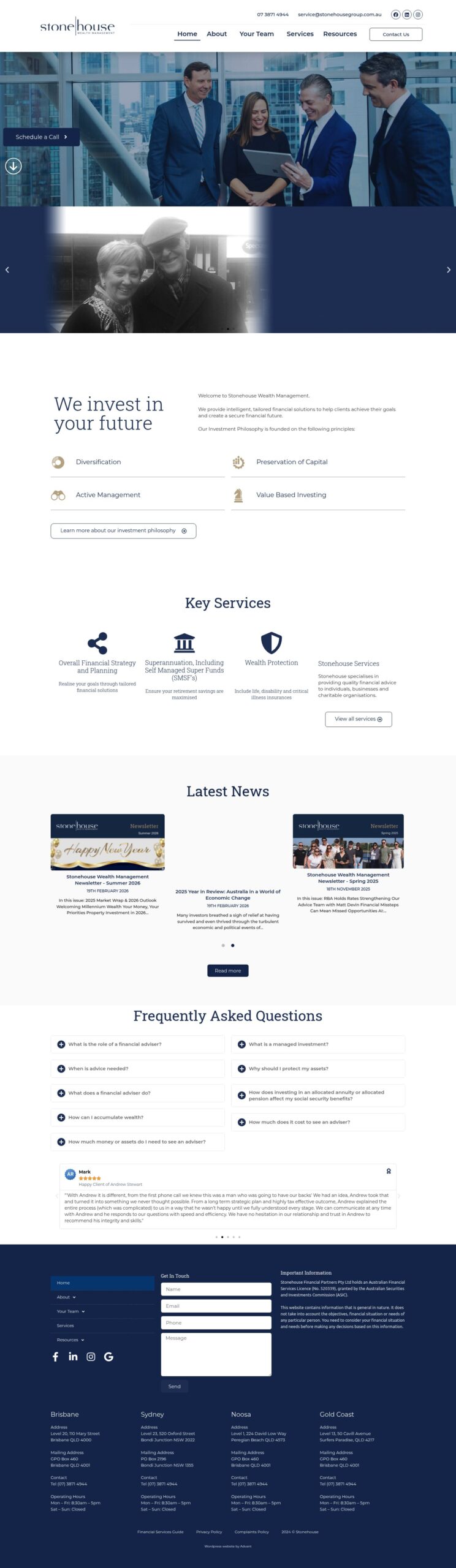
Stonehouse Group has built clear regulated credentials, a Brisbane base with offices across NSW and QLD, and a 5-star Google rating from 23 reviewers that signal strong local trust. Those assets are real, but much of the AFSL detail and client proof is buried in footers and slides, so high-value prospects—business owners, trustees and charity decision makers—leave before they see the proof. A quick, obvious path to book advice is missing where these buyers look first.
Your online reputation
5
Google star rating
23
Verified reviews
High
Reputation strength
Google Business Profile
Your online presence — what the data reveals
AI Visibility
Low
Authority Score
10
out of 100
Organic traffic
134
est. monthly visits
Traffic Trend
-35
%
past 12 months
Organic Keywords
179
ranking terms
Keyword Trend
+88
%
past 12 months
Backlinks
1033
total
Paid traffic
0
0 paid campaigns
Digital maturity
Level 2
out of 5
Stonehouse has two assets that competitors will struggle to copy: AFSL-backed credentials and a local reputation shown as a 5.0 rating from 23 Google reviews. The firm also has a meaningful link footprint with 1,033 backlinks from 165 referring domains, demonstrating real offline authority and referrals. If the website surfaces that AFSL status, reviews and local presence in the right places, those assets can be turned into predictable, high-value advisory enquiries.
How your website scores
TECH STACK
UX OBSERVATIONS
Trust signals are present but under-weighted: regulator and testimonial evidence is visible only in small footer or slide elements, reducing immediate confidence and raising verification friction for high-value prospects.
Value proposition fails to prioritise offers: the hero and headline are generic and do not guide visitors to a recommended service or audience segment, forcing prospects to hunt and increasing drop-off risk.
CTA hierarchy dilutes conversion intent: primary actions are small, low-contrast or placed off-peak (floating 'Schedule a Call' + footer form), so high-intent users face unnecessary steps and lower likelihood of converting.
Despite 1,033 backlinks and 165 referring domains, Stonehouse only receives about 134 organic visits a month and sits at a national search rank around 586,827, so visibility is low compared with the firm’s real-world standing. That gap means the firm is losing qualified advisory enquiries that its AFSL, five-star reviews and local offices should be generating.
The three gaps holding you back
What's possible when these gaps are closed
Move the AFSL badge, long heritage details and 5-star Google reviews (23 reviews) into prominent positions where decision-makers expect them. When those proofs are visible on the homepage and service pages, high-net-worth prospects and business clients are far more likely to trust and book a first call.
Use a clear hero that names a primary audience and a recommended next step so visitors do not have to hunt across multiple pages. With organic keyword visibility rising to about 180 keywords from 96 a year ago, a targeted homepage could turn that growing search interest into enquiries for specific services like retirement planning or succession advice.
Promote a single, high-contrast “Schedule a Call” action in the hero and on every service page so it is the obvious next step for visitors. With roughly 150 monthly visits, making CTAs visually and structurally prominent will convert the existing traffic into a steadier flow of qualified advisory enquiries.
This report was prepared by Redfox Digital using publicly available SEO, UX and reputation data.