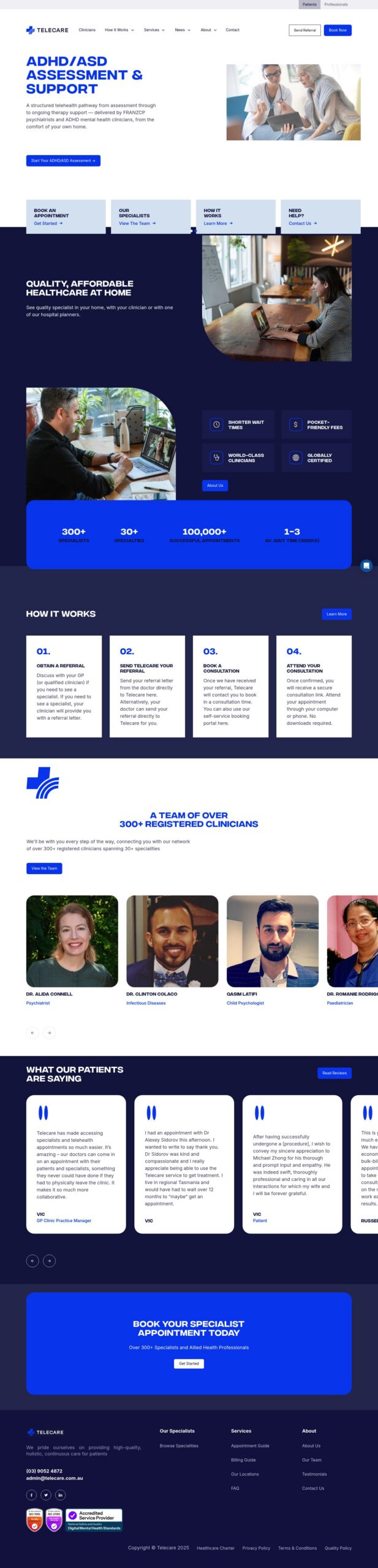
Telecare has built a genuine national network out of Blackburn, linking patients, GPs and hospitals to 300+ specialist clinicians across 30+ specialties and named partners such as Wentwest PHN and Murrumbidgee PHN. That credibility and partner list are strong, but the homepage and hero visuals read small and local, so hospital teams and GPs cannot verify the 300+ specialists or the claimed appointment volume when deciding whether to refer or partner. As a result, many institutional referrals and faster patient conversions are being lost before a conversation even starts.
Your online reputation
4.1
Google star rating
12
Verified reviews
Medium
Reputation strength
Google Business Profile
Your online presence — what the data reveals
AI Visibility
Moderate
Authority Score
26
out of 100
Organic traffic
1501
est. monthly visits
Traffic Trend
+52
%
past 12 months
Organic Keywords
678
ranking terms
Keyword Trend
+6
%
past 12 months
Backlinks
857
total
Paid traffic
0
0 paid campaigns
Digital maturity
Level 2
out of 5
Telecare has a real, hard-to-replicate asset: a network of 300+ clinicians covering 30+ specialties and visible partnerships with PHNs and hospitals such as Wentwest PHN and Mackay Hospital & Health Services. You also have meaningful online momentum: organic traffic has grown 52% year on year to about 1,500 visits per month and the site earns backlinks from 232 referring domains. If the digital presence is brought into line with that scale, those relationships and reach can convert into faster institutional referrals and larger partner contracts.
How your website scores
TECH STACK
UX OBSERVATIONS
Front-page focus on a specific clinical pathway (ADHD/ASD) dilutes the brand-level message and causes referrers or hospital partners to question whether the site represents a broad national service, creating lost referrals.
Trust artefacts (team photos, metrics, accreditation badges) are present but visually weak and scattered, under-signalling institutional credibility and reducing the persuasive impact needed to convert GP or hospital referrals.
Multiple equal-weight CTAs and mid-funnel content fail to prioritise a primary conversion for referrers versus patients, producing decision friction and lowering conversion efficiency for high-value referral pathways.
Despite a 52% increase in organic traffic to roughly 1,500 visits per month and 678 ranking keywords, low visibility nationally (search rank 118,088) and a modest authority score of 26 mean decision makers will not see the evidence they need. The mismatch between claimed scale and the site experience forces GPs and hospital teams into manual checks and extra phone calls, which slows referrals and raises the cost of onboarding partners. Until the site shows clear proof in the places institutional buyers look, referral volumes and contract wins will lag the network you have built.
The three gaps holding you back
What's possible when these gaps are closed
Make the 300+ specialists, 30+ specialties and partner names the first thing a GP or hospital buyer sees and can verify. Structured case studies, named partner pages and clear appointment figures will turn the claim of scale into evidence that accelerates trust and referral decisions.
Segment content so a GP or hospital contact can find the referral process and clinical evidence in two clicks, not by hunting through dense pages. Clear flows for referrals and partner onboarding will reduce friction, increase successful referrals and speed up partner contracting.
Align clinical and referral systems so hospital and PHN teams see confirmations and integration points up front rather than assuming manual processes. Demonstrating how referrals connect into partner workflows will lower the operational cost of each contract and make converting large institutional partners far more viable.
This report was prepared by Redfox Digital using publicly available SEO, UX and reputation data.