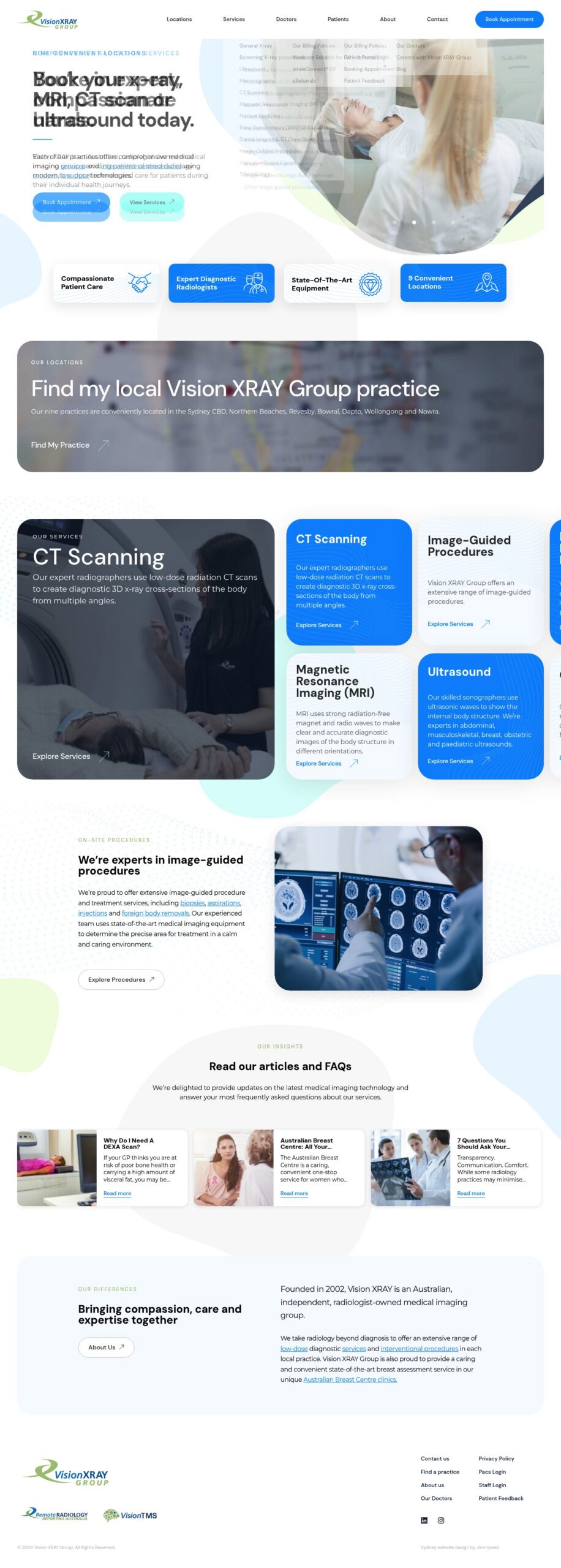
I reviewed Vision XRAY Group’s presence and the clinical foundation is strong: founded in 2002, radiologist-owned, operating across nine Sydney locations and running a dedicated breast centre. You also have real demand and local engagement, with about 9,116 organic visits a month and 154 Google reviews. The site downplays radiologist credentials and does not clearly signal VisionTMS or specialist referral pathways, so GPs, psychiatrists and patients are hesitating and higher-value referrals and predictable bookings are being lost.
Your online reputation
3.7
Google star rating
154
Verified reviews
Medium
Reputation strength
Google Business Profile
Your online presence — what the data reveals
AI Visibility
Moderate
Authority Score
27
out of 100
Organic traffic
9116
est. monthly visits
Traffic Trend
-9
%
past 12 months
Organic Keywords
4862
ranking terms
Keyword Trend
+22
%
past 12 months
Backlinks
3884
total
Paid traffic
0
0 paid campaigns
Digital maturity
Level 2
out of 5
The hardest to replicate asset is clinical scale and governance: a radiologist-owned group founded in 2002 operating from nine locations around Sydney. A second durable asset is reach and local validation: 154 Google reviews backed by a backlink footprint from 483 referring domains and 3,884 total backlinks. Those assets make it realistic to increase high-value referrals and predictable bookings if the online presence is updated to reflect clinical authority.
How your website scores
TECH STACK
UX OBSERVATIONS
Trust signals are present but not carrying enough visual authority; radiologist ownership and specialised services are buried in body copy instead of being elevated as primary credibility anchors, reducing referral conversion from clinicians.
The information hierarchy prioritises a single patient booking path and broad service tiles rather than distinct journeys for patients versus referrers, which fragments decision-making and causes missed specialist referrals.
Primary CTAs are visually competent but commercially underpowered; similar labelling and soft contrast drive transactional bookings but fail to promote higher-value actions such as clinician referrals, appointments for interventional procedures or specialist breast/TMS consultations.
There is demand and visibility to build on — about 9,116 monthly organic visits and 4,862 ranked keywords — but the site and local signals are not turning that traffic into reliable, higher-value referrals. With a 3.7 Google rating from 154 reviews and low message clarity and trust scores (3 and 2), many prospective referrers and patients will pause rather than book specialist pathways like VisionTMS or the breast centre.
The three gaps holding you back
What's possible when these gaps are closed
Lead with demonstrable credentials — founded 2002, radiologist-owned and operating from nine locations with 154 Google reviews — so referrers see clear clinical leadership. By foregrounding radiologist profiles, specialist centre details and short case examples, GPs and psychiatrists will be more likely to choose Vision XRAY for complex, higher-value imaging.
Reframe the visual hierarchy to reflect multi-site capability and specialist services such as the Australian Breast Centre and VisionTMS so the homepage reads like a major radiology provider. Improving message clarity and visual maturity from current scores of 3 and 2 will help justify higher-fee services and lift the quality of incoming referrals.
Convert existing organic interest — roughly 9,116 monthly visits and a 4,862-keyword footprint — into predictable bookings by simplifying service pages and prioritising referral CTAs for GPs and psychiatrists. Simple fixes like dedicated pathway pages, quick suitability checklists and one-click referral forms will reduce friction and increase high-value bookings without needing more traffic.
This report was prepared by Redfox Digital using publicly available SEO, UX and reputation data.