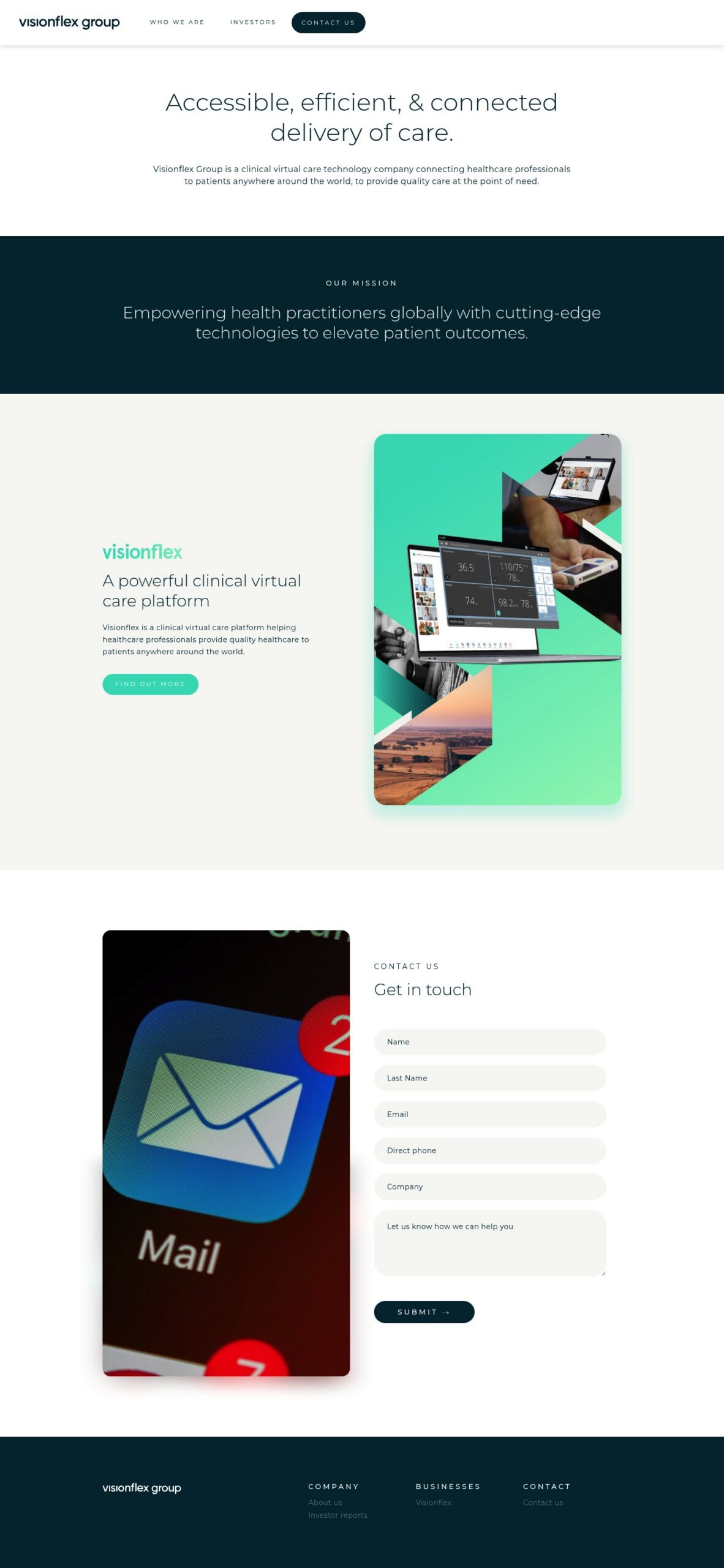
Visionflex Group has built real credibility in Melbourne and across Australian healthcare, supplying integrated hardware and software to Primary Health Networks, local health districts, aged-care providers and community health services. The public site, however, reads like a hands-on physiotherapy clinic: the hero image, service grid and team content position a consumer clinic experience rather than an enterprise platform. That mismatch means procurement and partner buyers land on the site, see a consumer experience and leave before requesting demos or pursuing contracts.
Your online reputation
5
Google star rating
5
Verified reviews
Medium
Reputation strength
Google Business Profile
Your online presence — what the data reveals
AI Visibility
Low
Authority Score
17
out of 100
Organic traffic
7
est. monthly visits
Traffic Trend
-42
%
past 12 months
Organic Keywords
9
ranking terms
Keyword Trend
-50
%
past 12 months
Backlinks
4381
total
Paid traffic
0
0 paid campaigns
Digital maturity
Level 2
out of 5
You have two assets that are hard to replicate: a perfect Google rating of 5.0 from 5 reviews, and an existing backlink footprint of 4,381 links from 332 referring domains. If the digital presence is reshaped to speak to institutional buyers, those assets can be turned into credible proof points and fuel larger procurement conversations and demo bookings.
How your website scores
TECH STACK
UX OBSERVATIONS
Visual tone signals a consumer clinic experience rather than an enterprise clinical-technology vendor, causing procurement and institutional buyers to self-select out.
Enterprise trust markers are present or implied but not carrying enough visual authority, diluting credibility and increasing friction in RFP, security and procurement conversations.
Primary CTAs and decision pathways are weak and ambiguous, failing to channel enterprise buyers to demos, technical collateral or procurement contacts and leaking conversion into low-signal contact-form submissions.
With only 7 organic visits per month and rankings for 8 keywords, Visionflex is effectively invisible to the procurement teams searching for enterprise virtual care platforms. That invisibility persists despite 4,381 backlinks from 332 domains, which shows signals exist but are not driving the right visibility. The clear business consequence is missed procurement conversations and a stalled demo pipeline for larger contracts.
The three gaps holding you back
What's possible when these gaps are closed
Lead with the platform story and enterprise use cases to convert institutional interest into demo requests. Replacing clinic-style hero imagery and service tiles with case studies, deployment examples and clear procurement contacts will make it obvious to PHNs and local health districts that Visionflex is a partner for system-level care. That change directs existing awareness into actionable demo bookings and procurement talks.
Leverage the existing 4,381 backlinks and 332 referring domains by aligning content to enterprise queries so those links actually lift visibility for procurement terms. Right now the site gets 7 visits a month and ranks for 8 keywords; targeted pages and better content alignment can convert that link equity into meaningful search traffic from decision-makers. More relevant organic traffic makes it far easier for procurement teams to discover and evaluate Visionflex.
Make the primary calls to action focus on demos, resources for buyers and procurement contact forms instead of patient bookings. Giving institutional visitors an obvious next step removes friction and increases the chance a hospital, PHN or aged-care network progresses from interest to a procurement conversation. That change will start turning institutional visits into scheduled demos and formal procurement enquiries.
This report was prepared by Redfox Digital using publicly available SEO, UX and reputation data.