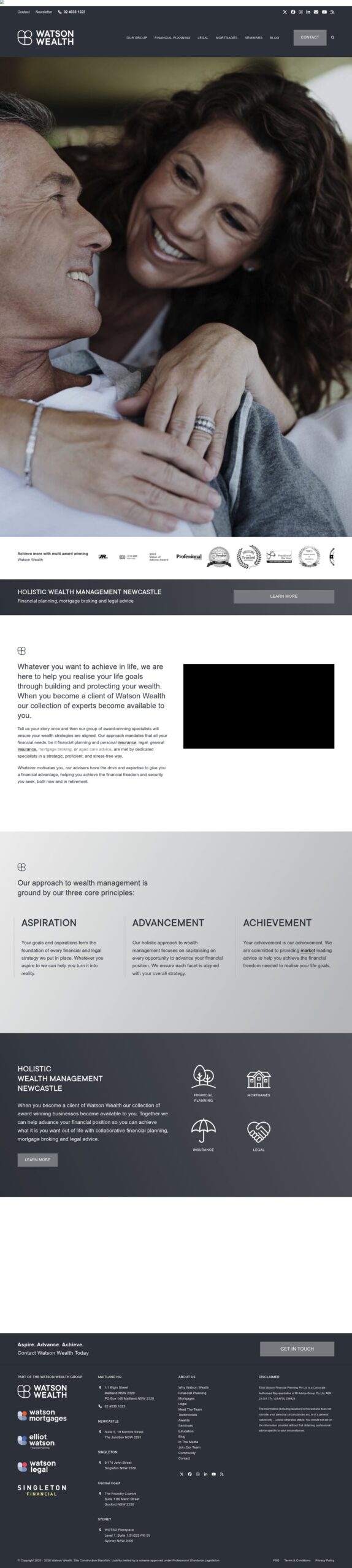
Watson Wealth has built strong credibility in Newcastle and the Hunter, with a 5.0 Google rating from 72 reviews and a multidisciplinary practice offering financial planning, mortgage broking, legal and aged-care advice across regional NSW and Sydney. That reputation and service breadth are not translating into predictable, high-value online enquiries because the site does not present clear, segmented decision paths or visible expert proof at the moment people choose a provider. As a result, complex clients who need a specific specialist are likely dropping away or turning to firms that make the next step obvious.
Your online reputation
5
Google star rating
72
Verified reviews
High
Reputation strength
Google Business Profile
Your online presence — what the data reveals
AI Visibility
Low
Authority Score
13
out of 100
Organic traffic
253
est. monthly visits
Traffic Trend
+207
%
past 12 months
Organic Keywords
230
ranking terms
Keyword Trend
+314
%
past 12 months
Backlinks
199
total
Paid traffic
0
0 paid campaigns
Digital maturity
Level 2
out of 5
Watson Wealth’s hardest-to-copy assets are a flawless local reputation, shown by a 5.0 Google rating from 72 reviews, and a genuine multidisciplinary offering that combines financial planning, mortgages, legal and aged-care advice across Newcastle and the Hunter. Those two elements mean you already have both endorsement and scope that competitors would struggle to match quickly. If your digital presence catches up to those strengths, you can reasonably convert more of that local credibility into steady, higher-value enquiries.
How your website scores
TECH STACK
UX OBSERVATIONS
Trust signals are present but not carrying enough visual authority: award badges and ‘award‑winning’ claims are too small and uncontextualised to convert credibility into enquiry.
The homepage fails to structure decision-making for complex buyers: no prominent, distinct entry points for Financial Planning, Mortgages, Legal or Aged Care forces visitors to hunt for the right path.
Conversion intent is diluted by non‑transactional CTAs and low visual contrast: primary action (‘Learn more’) is passive and visually muted, reducing likelihood of booking calls or capturing high‑value leads.
Having a 5.0 rating from 72 reviewers alongside only a few hundred organic visits a month and an authority score in the low teens creates a clear business gap: local trust exists but it is not reaching or converting a broader pool of qualified prospects. The recent rise in keywords and traffic shows demand is growing, yet without clear service entry points and active qualification, that interest will continue to produce inconsistent, low-value enquiries instead of reliable, scheduled meetings. In short, reputation plus growing visibility could deliver regular high-value work, but the current setup is leaving those opportunities on the table.
The three gaps holding you back
What's possible when these gaps are closed
Lead with the 5.0 Google rating and 72 reviews where people are choosing a provider, not buried on a reviews page. Prominent, contextualised review excerpts, client outcomes and award mentions on service pages and landing pages make the social proof visible at the moment of decision and reduce hesitation for higher-value prospects.
Create clear, separate entry points for financial planning, mortgages, legal and aged-care so busy families and older clients can find the right path in one click. Simple, service-specific landing pages and CTAs tailored to each need will cut the friction that currently forces prospects to hunt or abandon the site, and will lift the quality of enquiries from regional NSW and Sydney.
Move from passive CTAs to short, purposeful qualification flows and automated follow-up so the enquiries you already get turn into booked meetings. Given traffic has risen to around 300 visits most months, even modest increases in capture and follow-up consistency should produce many more qualified, high-value conversations.
This report was prepared by Redfox Digital using publicly available SEO, UX and reputation data.