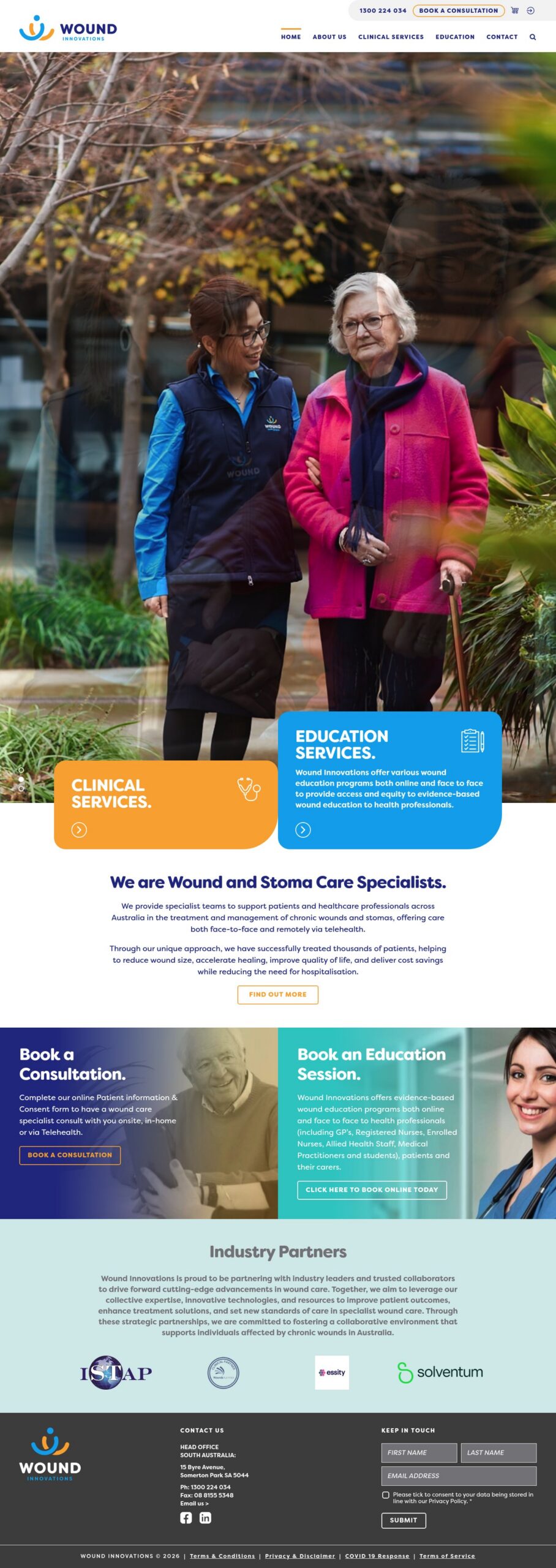
Wound Innovations has built real clinical credibility from Adelaide with face-to-face and telehealth services across Australia, delivering more than 40,000 consultations for hospitals, aged care, disability services and individual patients. That measurable track record and national footprint are not turning into predictable bookings or institutional contracts because the site and messaging do not make your proof and decision paths obvious. As a result, hospital, aged-care and NDIS buyers are not finding or shortlisting the evidence they need at the moment they make decisions.
Your online reputation
Google star rating
Verified reviews
Medium
Reputation strength
Google Business Profile
Your online presence — what the data reveals
AI Visibility
Low
Authority Score
21
out of 100
Organic traffic
128
est. monthly visits
Traffic Trend
+246
%
past 12 months
Organic Keywords
233
ranking terms
Keyword Trend
+16
%
past 12 months
Backlinks
2004
total
Paid traffic
0
0 paid campaigns
Digital maturity
Level 2
out of 5
You have delivered over 40,000 consultations and a genuine national footprint, including face-to-face and telehealth services for hospitals, aged care and disability providers across Australia. You also have an established referral network reflected in 306 referring domains. If the digital presence catches up, those two assets make it realistic to turn measurable outcomes into predictable hospital and aged-care contracts and steady telehealth bookings.
How your website scores
TECH STACK
UX OBSERVATIONS
Hero dominance without a primary commercial action reduces immediate conversion; high-value buyers must scroll for proof so initial momentum to book or enquire is lost.
Trust signals are present but under-signalling credibility; partner logos and contact details are visible yet there are no prominent clinical KPIs, accreditation badges or case outcomes above the fold, diluting institutional confidence.
Multiple same-weight CTAs and service tiles create decision friction; the site fails to guide distinct buyer journeys (institutional procurement, telehealth patients, education purchasers), lowering conversion efficiency for each segment.
With only 128 organic visits a month and a national search rank of 595,316, strong clinical results are not being seen by the institutional buyers who matter. An authority score of 21 and low visibility mean procurement teams and referrers cannot quickly verify your outcomes, so opportunities are being lost before conversations begin. The recent traffic growth from 37 to 128 shows momentum, but without clearer evidence and decision paths that momentum will not translate into contracts.
The three gaps holding you back
What's possible when these gaps are closed
Putting your >40,000 consultations and high healing-rate summaries where procurement and referrers look would turn implied credibility into shortlisted status. Short, prominent case snapshots and partner badges on clinical pages would make it far easier for hospitals and aged-care buyers to verify your claims quickly.
Clear, visually prominent CTAs and dedicated institutional pages can turn casual visitors into telehealth bookings and contract enquiries. With 128 monthly organic visitors, even a small uplift in booking rate and a clear RFP path could create a steady stream of predictable bookings and enquiries from hospitals and NDIS providers.
Reframing hero imagery and page layouts to signal wound and stoma specialisation will reduce cognitive friction for aged-care, hospital and NDIS decision makers. When the site looks as specialised as your service and national footprint, your outcome statistics and referral network will carry far more weight in procurement conversations.
This report was prepared by Redfox Digital using publicly available SEO, UX and reputation data.