You’ve done the hard part. People are finding you. The ads are running, the SEO is working, the content is pulling in the right search terms. Traffic is up and the reports look healthy.
So why isn’t revenue following?
This is one of the most common and quietly expensive problems in a growing service business. And the instinct, almost universally, is to look upstream. More traffic. Better targeting. A stronger campaign. If the leads aren’t converting, the assumption is that something at the top of the funnel needs fixing.
But the problem usually isn’t upstream at all. It’s what happens after someone lands on your site. And in most businesses, that part has never actually been designed.
Your website was built to be viewed, not navigated
Most business websites are assembled over time rather than architected from the start. A new service gets added, so a page goes up. Marketing starts a blog for SEO. Campaigns need landing pages, so those get built. Each decision made sense when it was made.
But step back and look at the whole thing, and what you usually find is a collection of pages that each try to do everything on their own, without any consideration for where the visitor came from, what they already know, or what they need to understand before they’ll take the next step.
There’s no shortage of content or capability. The problem is that the site behaves like a set of disconnected endpoints. Users land, browse briefly, hesitate, and leave. Not because they weren’t interested. Because nothing showed them where to go next.
This is the conversion pathway problem. And it’s structural, not cosmetic.
The funnel model doesn’t reflect how your buyers actually behave
The traditional conversion funnel is a tidy concept. Awareness leads to consideration, which leads to a decision. It’s easy to diagram and easy to report on.
It’s also not how real buyers move.
A business owner searching for help with a specific problem might find you through a blog post, read it, close the tab, see a remarketing ad three days later, click through to your services page, hunt around for proof that you’ve solved this problem before, fail to find it quickly enough, and leave again.
That’s not a funnel. It’s a journey with multiple entry points, uneven pacing, and a set of questions that need answering in a particular order before a decision feels safe.
Funnels are useful for analysing what happened after the fact. They don’t help you design for what should happen. And in a high-consideration service business, where the sales cycle is longer and the stakes feel higher to the buyer, that distinction matters enormously.
Conversion pathways are what fill that gap.
What conversion pathways actually do
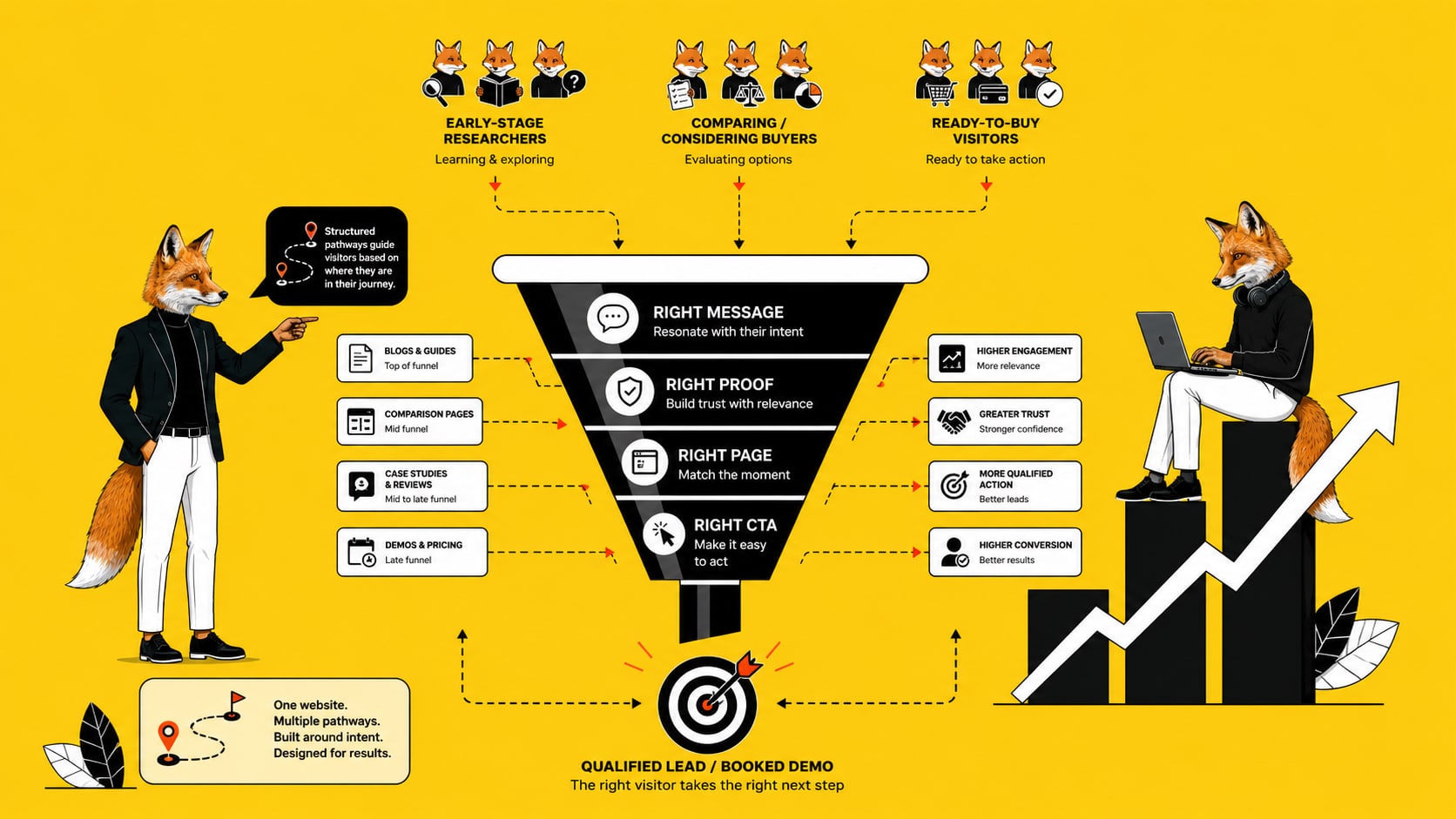
A conversion pathway is a structured route through your website that guides a specific type of visitor toward a specific action, based on where they are in their decision-making process.
The key word is specific. Not all visitors are in the same place. Someone who just discovered they have a problem needs context and reassurance before anything else. Someone actively comparing providers needs proof, capability, and a frictionless next step. Treating those two people identically, which is what most websites do, means you’re failing both of them.
Conversion pathways recognise that distinction and design for it. They connect entry points to relevant next steps. They distribute the work of building confidence across a sequence rather than trying to do it all on one page. Each step answers a specific question: Is this relevant to my situation? Have they solved this problem before? What does working with them actually look like? What should I do now?
When those questions are answered in the right order, users don’t need to be pushed toward a decision. They move because the next step makes sense.
Why hesitation is the real conversion killer
Most conversion problems come down to a single thing: unanswered uncertainty.
Visitors don’t leave because they lack interest. They leave because something doesn’t add up, or because the next step isn’t obvious, or because they can’t quickly find the thing that would tip them from curious to confident.
This is where most businesses reach for the wrong fix. They rewrite the headline, test a new call to action, or redesign the hero section. These things can help at the margins, but if the underlying structure doesn’t support the user’s decision-making process, you’re optimising the surface while the foundation stays broken.
The businesses that see real, lasting improvement in conversion aren’t the ones that found better button copy. They’re the ones that restructured how their site guides people through uncertainty, step by step, until action feels like the obvious next move.
Why this problem persists even in well-run businesses
Conversion pathways fall through the gaps because they sit between disciplines.
Marketing is focused on driving traffic. Design is focused on how pages look and feel. Development is focused on building what’s been briefed. Nobody owns the question of how users move across the whole system.
There’s also a persistent bias toward acquisition. Traffic is visible. It shows up in dashboards, it responds quickly to spend, and it’s easy to point to as evidence of progress. Structural work on the site is slower, less dramatic, and harder to attribute. So it gets deprioritised, even though it’s often where the bigger opportunity sits.
The result, in most growing businesses, is a site that has accumulated significant content and capability but has no clear movement built into it. More pages, more entry points, more complexity. And a conversion rate that stays stubbornly flat no matter how much traffic increases.
From the outside it looks like a performance problem. It’s actually an architecture problem.
What changes when pathways are built properly
When conversion pathways are properly designed, the shift isn’t in how much traffic you’re getting. It’s in what that traffic does when it arrives.
We’ve seen this with service businesses that had strong inbound numbers but inconsistent enquiry quality. High-intent visitors were being routed through the same generic experience as people who had just discovered the brand. They had to work too hard to find what they needed, and by the time they got there, the moment had passed.
Once the pathways were restructured around intent, things changed quickly. Users moved more directly toward relevant actions. Enquiries improved in quality, not just volume. Sales conversations started at a higher level because prospects arrived already understanding the approach and already partway through their own decision process.
The difference wasn’t more marketing activity. It was better alignment between what the visitor needed and what the site gave them at each step.
Conversion is a sequence, not an event
The most useful way to think about conversion pathways is this: conversion is never a single moment. It’s the outcome of a sequence of smaller decisions, each one either moving a user forward or creating enough friction that they stop.
Which means the right question isn’t “is this page converting?” It’s “what does this page enable next?” Does it reduce uncertainty? Does it build the right kind of confidence? Does it hand the user to the next step with enough context that the transition feels natural?
When every page has a clear role in that sequence, the site stops being a collection of assets and starts functioning as a system. And systems scale in a way that individual pages never do.
Visibility without conversion is just expensive awareness
Bringing people to your site is only valuable if your site is built to move them forward. Without clear conversion pathways, traffic spend becomes awareness spend, and awareness without action doesn’t grow a business.
At Redfox, conversion rate optimisation is one of the four pillars of our Authority and Acquisition system, sitting alongside SEO, paid media, and retention. We treat it as a structural discipline, not a campaign fix, because that’s where the compounding value actually lives.
If your traffic is healthy but your pipeline feels inconsistent, the pathway is likely where the problem sits.