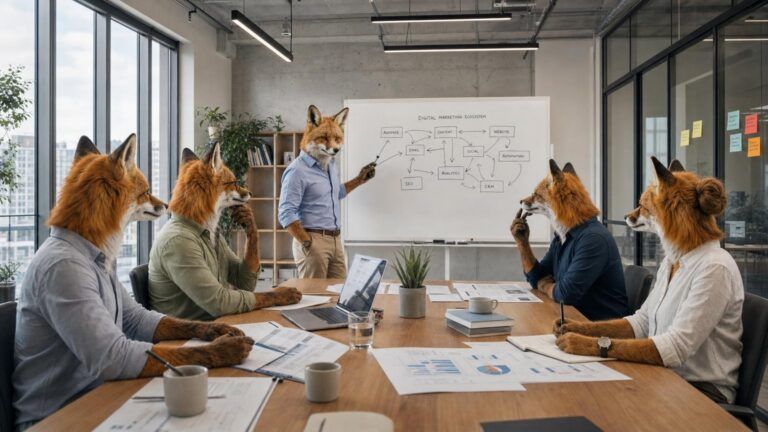
Why established businesses lose enquiries in the gaps between channels, and the joins to check first
A manufacturer with 25 years of work behind it has a website, a Google Ads account, a mailing list and someone posting on LinkedIn most weeks. Each piece does something. Enquiries still arrive in bursts, nobody can say which part earned them, and the slow months feel like bad luck that nobody can name. That’s usually a digital marketing ecosystem problem, and it shows up in the joins between the parts. The first move is knowing what should connect to what, and where yours stops.
What a digital marketing ecosystem is
Your digital marketing ecosystem is everything a buyer touches between hearing your name and becoming a customer, plus the systems sitting behind it. That includes search visibility, ads, your website, the content on it, your email program, the CRM that holds the enquiry and the reporting that tells you what happened. Most established businesses already own all of it. What they often don’t own is the path through it.
The word earns its place because the parts depend on each other. Good content doesn’t help if your service pages never point to it. Ad spend doesn’t convert if the landing page answers a different question than the ad asked. A well-written follow-up email never gets sent if the form submission lands in an inbox instead of the CRM. The channel is rarely the problem on its own.
That matters more now because almost everyone is reachable this way. Kepios analysis puts Australia’s internet penetration at 97.1 percent of the total population at the end of 2025. Your buyers are online. The question is what they find, and what happens next.
Why the joins matter more than the parts
Think of it as a loop. Something makes a buyer aware of you, the website gives them enough to trust you, the enquiry reaches a person, the follow-up moves it along, and what you learn from that cycle tells you where to put the next dollar. Every stage hands over to the next one. Break a handover and the stages either side still look fine in their own reports.
This is why channel-by-channel reporting can look healthy while the business feels stuck. Traffic is up, impressions are up, the posts get likes. But the sales team says the leads are the wrong kind, and nobody can trace a closed deal back to anything. We see this a lot. The individual specialists are each doing their job, and no one owns the line between them.
Where these ecosystems break
In our experience, the same five joins account for most of it.
The form and the CRM. A Gravity Forms submission goes to one person’s inbox and never reaches HubSpot or ActiveCampaign. Enquiries get handled, mostly, but there’s no record of source, no routing and no follow-up sequence. When that person is on leave, enquiries sit.
The ad and the page it lands on. Google Ads sends someone searching for a specific service to a general homepage. They have to find their own way. The click was paid for and the question went unanswered.
The content and the money pages. Articles get written, then live in isolation. Nothing on the relevant service page links to them, so a reader who wants more detail can’t get it and a search engine can’t see the relationship.
The enquiry and the follow-up. One reply goes out, then silence. For a considered purchase, most buyers aren’t ready on day one, so the ones who were “just looking” are the ones you lose.
The numbers and the decision. GA4 is installed but conversions aren’t tracked properly, so reporting counts sessions where it should count opportunities. As a result, budget moves on instinct.
Questions to ask before you spend more
Before approving another campaign or quote, put these to whoever runs your marketing. The answers tell you more than a dashboard will.
- Where does a website enquiry go, step by step, and who touches it first?
- Which pages do our ads land on, and do those pages answer the search?
- What happens to an enquiry that doesn’t buy in the first fortnight?
- Can we name the source of the last five customers we won?
- If we doubled traffic tomorrow, which step would break first?
If the answers are vague, that’s your diagnosis. The underlying plan deserves attention too, and we’ve written separately about what a digital marketing strategy should contain and how to tell if yours is doing its job.
What it looks like when the joins hold
Someone with a problem searches a question. They find an article that answers it properly, and that article points to the service page for the work involved. The service page explains the approach, shows relevant evidence and makes the next step obvious. They complete a form. The enquiry reaches the CRM with its source attached, routes to the right person and triggers a short follow-up sequence while they decide. Three months later, you can see which search started it.
None of that is exotic. It’s ordinary plumbing, done deliberately. The reason it’s rare is that each piece was usually built by a different person at a different time, with nobody responsible for the line between them.
Frequently asked questions
Strategy is the decision: who you’re for, what you say and where you compete. The ecosystem is the set of channels, pages and systems that carries that decision to a buyer, including the handovers between them.
No. Two or three channels that pass people along properly will beat six that run separately. Adding a channel to a broken join just spreads the leak.
Trace one real enquiry backwards, from the sale to the first click. The step where the trail goes cold is almost always the step that needs work.
Yes, in most cases. Tracking, routing, follow-up and page-level changes solve plenty of it, and a rebuild is one option among several.
Start with the enquiry you can’t trace
Take the last enquiry that went quiet and follow it through every system it touched. You’ll find the handover that failed, and it’s usually cheaper to fix than the campaign you were about to approve. Do that before you add a channel, because a new channel feeds the same path your current enquiries already fall out of.
Redfox Digital is a Sydney-based digital growth agency. We’ve spent more than 20 years helping established businesses find where growth gets stuck, and we bring strategy, marketing, technology and execution together under one roof, so businesses don’t have to coordinate five different specialists just to solve one problem.
If you’d like a second pair of eyes on the joins in your own setup, we’re happy to have a look. Book a discovery call.